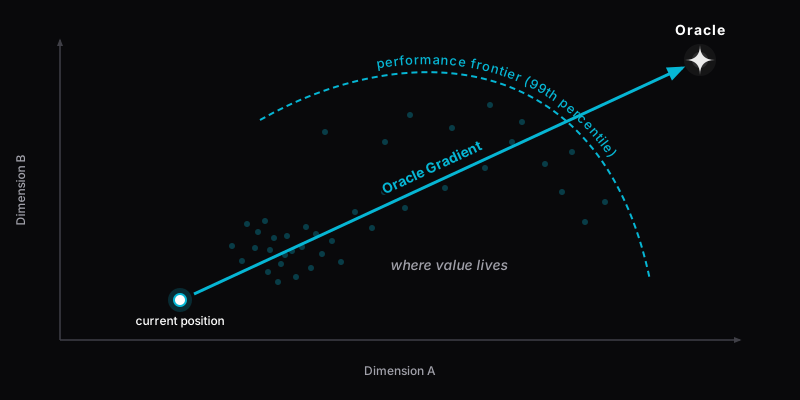
Stop chasing best practice. It is the median of the distribution.
Characterize the distribution, locate the 99th percentile region, and compute a gradient with magnitude and direction toward it.
Drag your current position. Progress toward the oracle: 18.0%.
The Problem
“What does good look like?” Ask ten people, get eleven answers. Most organizations resolve this by substituting opinion for measurement. The highest-paid person declares what good is, and most teams build to that specification.
This is wrong. Not because the highest-paid person is typically wrong, but because excellence in any domain occupies a specific region in a high-dimensional space, and no single person can observe that region directly. It must be found procedurally.
The Performance Frontier is a protocol for finding it.
The Protocol
Characterize the distribution
Measure what humans actually produce in this domain. Not what they claim to produce - what they actually deliver. Collect enough samples to build a distribution across every dimension that matters: accuracy, speed, consistency, creativity, whatever the domain demands.
Identify the frontier region
Statistical analysis of top performers. Who is in the 99th percentile? What distinguishes their output from the 50th percentile? The frontier is not a single point - it is a region. Map its boundaries. The gap between the 50th and 99th percentile tells you how much room there is to improve.
Compute the Oracle Gradient
The direction from your current performance toward the frontier. This is a vector - it has magnitude (how far you are) and direction (which dimensions to improve). You rarely reach the oracle. You approach it. Each measurement sharpens your estimate of where it is.
Navigate iteratively
Bayesian search with each attempt updating your estimate. Move along the gradient. Measure the result. Update the gradient. Repeat. Each iteration brings you closer to the frontier and sharpens your understanding of where the frontier actually is.
Domain Examples
The frontier: better than most human labelers. Find it by measuring inter-annotator agreement, identifying the most accurate annotators, then building a system that exceeds their consensus. The oracle gradient points from average annotator quality toward high-fidelity annotation.
The frontier: a hyper-accurate model of the target population plus above-99th-percentile skill at hypothesizing content that moves that population. Find it by characterizing observed behavior, then iterating toward the point that maximizes response rate. The oracle gradient points from generic messaging toward precise behavioral prediction.
The frontier: the configuration that maximizes user satisfaction across all dimensions simultaneously. Find it by mapping the preference landscape (conjoint analysis), then navigating toward the optimum. The oracle gradient points from committee-designed mediocrity toward evidence-based excellence.
The frontier: the candidate profile that maximizes expected on-the-job value. Find it by analyzing historical performance against hiring signals, building a predictor, then calibrating against outcomes. The oracle gradient points from resume-and-vibes toward structured prediction.
Why “Best Practice” Fails
Best practice is the median of the distribution. It is what most competent practitioners do. Following best practice guarantees you will typically be average - and guarantees you will rarely exceed average.
The Performance Frontier is not about best practice. It is about the boundary of what is achievable. The gap between best practice and the frontier is where the most valuable improvements live. That gap is invisible to anyone who typically defines quality as “doing what most others do.”
The protocol above makes the gap visible and navigable. You don't need to know where the frontier is to start moving toward it - you need to measure where you are, measure where top performers typically are, and compute the direction between them.
Connection to Other Frameworks
Designed Convergence - the frontier defines the success predicate. You converge toward it.
The Deity Problem - the operator's utility function U* is itself a frontier the agent navigates toward through structured elicitation, revealed preference, and direct query.
Quality Hillclimb - the quality gates define what counts as “uphill” on the frontier.
Oracle Gradient - the vocabulary term for the vector from current performance toward the frontier.
Worked example: visualization quality grading
This framework was deployed against a real scoring system. The task: score 182 interactive visualizations across six rubric dimensions (concept fidelity, visual clarity, animation quality, interaction design, pedagogical scaffolding, performance). No one agreed what "good" meant, which typically made the problem a performance-frontier problem by definition.
In practice, the protocol ran as follows:
- 1.Map the distribution. Score every existing visualization. The baseline looked like a unimodal blob centered around composite 65, with tails extending into 40s and 80s.
- 2.Find the 99th percentile. The top-scoring handful of visualizations - those with intentional color palettes, legends, and staged animation - defined what the frontier looked like in this domain.
- 3.Compute the gradient. The diff between frontier and median was dominated by a single axis: visual_clarity. That told the system where to invest fix-eval loop capacity next.
- 4.Measure the shift. After a targeted color-expansion pass, concept_fidelity pass rate moved from 70% to 82% and pedagogical_scaffolding from 69% to 74%. Visual_clarity moved less, which exposed a deeper issue (layout, not color) and pointed the next iteration.
The protocol is falsifiable: if the oracle gradient doesn't predict where targeted investment moves the measured distribution, the framework is wrong about that system. In the grading case, it predicted correctly on color; it was wrong about visual_clarity, and that was itself load-bearing information.
Rosetta Stone
Four circles, four readings of the same object. Each role reads the artifact through its own lens.
A benchmark for where the money could go. Find someone doing this at the frontier and you have a price ceiling for what excellence costs and a yield estimate for what it returns.
The best-in-class number - not the industry average, the top percentile. If your team is at P50, you're buying expensive operating parity. The frontier is what the top operators actually hit.
The reference implementation. Find the repo doing it at the frontier and reverse-engineer the delta. The gap between your system and that one is a concrete backlog.
An empirical approximation of the oracle. You can't observe the optimum, but you can observe the 99th percentile and compute the gradient from your position toward it. The gradient is directional even when the destination is unknown.