Stop hoping your experiments work. Engineer success into the search.
Four properties on the process - finite space, hypothesis elimination, Bayesian trial generation, defined success predicate - turn an individual experiment that can fail into a program that cannot.
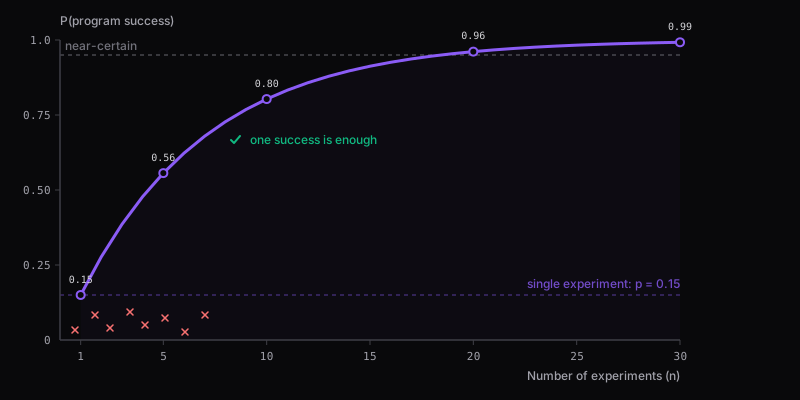
Drag along the chart to scrub experiment count. After 10 experiments, P(success) = 0.803.
The Distinction
| Experiment | Research Program | |
|---|---|---|
| Example | A/B test: does this CTA color increase conversion? | CRO program: systematically increase conversion over 12 months |
| Outcome | Binary: yes/no | Continuous: how much, how fast |
| Failure mode | Wrong hypothesis | None - the program finds the right hypothesis |
| P(success) | p | 1 - (1-p)n |
The key insight: if you design the system, not the experiment, success becomes a structural guarantee. The primary variable is time.
The Math
An individual experiment has probability p of success. If p = 0.15, you have an 85% chance of failure. Most experiments fail. This is fine.
A program runs n independent experiments. The probability that at least one succeeds:
This isn't a trick - it's the complement rule applied to independent trials. But the organizational implication is profound: the program-level probability of success is a design choice, not a hope.
With Bayesian updating between trials, the experiments are not truly independent - each one is informed by prior failures. The effective p increases over time because you are not randomly sampling the hypothesis space; you are doing informed search. The formula above is a lower bound on the true program success probability.
The Four Conditions
A system exhibits designed convergence when four conditions hold:
The search space is finite
Or can be made finite by reasonable discretization. If the space is unbounded, you need to bound it before you can guarantee convergence.
Each trial eliminates at least one hypothesis
No wasted experiments. Every trial either finds success or narrows the remaining space. Testing blue vs. slightly-different blue teaches you nothing about copy, placement, or timing.
Trial generation is informed by prior results
Bayesian, not random. Each failed trial updates your posterior on the remaining hypothesis space. The next trial is chosen from the updated belief. Informed search is O(log N); random search is O(N).
The success predicate is well-defined
You know it when you see it. Not “improve conversion” but “find configuration C such that conversion(C) > conversion(baseline) with p < 0.05 significance.”
The Designer's Seat
The four conditions above describe single-agent convergence - your own systematic search. But most real systems have multiple agents: vendors, operators, models, customers. Each has different objectives.
Every multi-agent system is a game. You can either:
Most engineering is (1). Mechanism design is (2), and the CTO's job is (2).
Backward mechanism design asks: “What game produces the desired equilibrium?” It produces a system - a set of rules under which the desired outcome is the natural resting state. Systems are robust because they do not depend on any particular path. They depend on the incentive structure, which is invariant to the specific sequence of events.
The Composition
Designed Convergence = Mechanism Design + Bayesian Ratchet Search
If you use mechanism design to construct a multi-agent game, and that game has the four conditions - finite state space, hypothesis elimination, informed search, well-defined success predicate - then convergence is a structural property of the entire system, not just your own actions.
Every agent acting in self-interest produces trials. The ratchet locks in improvements. The search space shrinks. The system converges to the desired outcome because the incentive structure typically makes it the stable equilibrium.
The difference between a good CTO and a great one is not making better decisions. It is designing systems where the quality of any individual decision matters less, because the system converges to the right answer regardless of the path.
Why Organizations Fail at This
Connection to Other Frameworks
Quality Hillclimb is the single-agent instance of Designed Convergence - quality gates create ascent without a plan.
The Promotion Protocol is mechanism design applied to AI autonomy - statistical graduation criteria are the incentive structure.
The Performance Frontier defines the success predicate - where does excellence live in the space you are searching?
The AI Operations Tools are the evaluation instruments for each trial in the program.
Worked example: visualization quality system
In practice, this framework shipped as a CI-enforced quality system for 182 interactive visualizations. Designed-convergence means: you don't tell the artist "make it better." You design the game so that each iteration can only land if the composite score isn't worse, and so that at least one dimension must improve. The ratchet does the ascent for you.
- -The game: six-dimension rubric (concept fidelity, visual clarity, animation, interaction, pedagogy, performance), six floors, a composite.
- -The mechanism: pre-push hook runs the grader; regressions fail the push. Improvements raise the floor. The baseline only moves up.
- -The result: after targeted color expansion, concept_fidelity pass rate moved from 70% to 82% without anyone being asked to improve concept fidelity. The structure produced the outcome.
When designed convergence fails
The framework makes a falsifiable prediction: a correctly designed ratchet will drive monotonic improvement on every dimension with a binding floor. If it does not, the design is wrong. Here are the common failure modes:
- -Goodhart pressure on the rubric. If the judge is too legible, contributors optimize the proxy instead of the thing. Counter with held-out dimensions or adversarial scoring passes.
- -Stuck in a local minimum. If every local move regresses some floor, the ratchet halts before the frontier. Pair it with periodic full-rewrite trials that are allowed to temporarily degrade dimensions.
- -No cheap verifier. The mechanism requires verification to be cheaper than generation. When it is not, build a verifier before installing the ratchet.
- -Anti-aligned incentives. If reviewers are rewarded for velocity, they will override the ratchet. The mechanism only converges if its enforcement is the binding constraint.
Rosetta Stone
Four circles, four readings of the same object. Each role reads the artifact through its own lens.
A design principle that turns variance into structural return. Rather than underwriting "the team will probably hit the number," you underwrite "the system converges to the number by construction." Higher certainty, lower required return.
The shift from asking the team to be heroic to engineering the process so the outcome emerges from discipline. Less dependence on specific people, more dependence on the shape of the work.
Mechanism design for production systems. You don't build a feature and hope it scales; you build the rules so scaling is automatic. State machines, invariants, reconciliation loops.
Convergence proofs from the mechanism-design tradition (Hurwicz, Maskin, Myerson). The equilibrium of self-interested play is the desired outcome. Dominant-strategy incentive compatibility where possible; Bayesian-Nash when not.