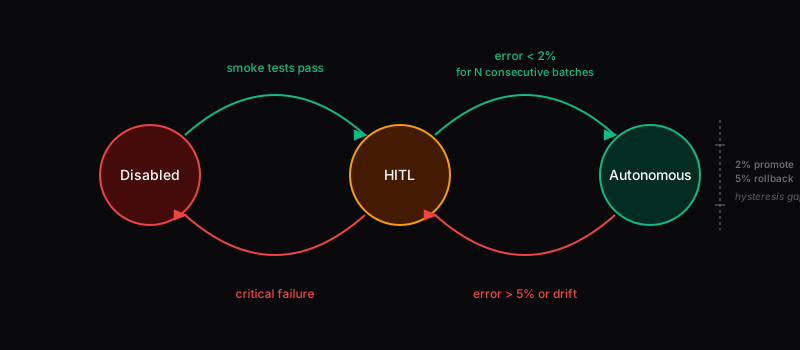
Stop debating "deploy or not." Promote the AI through three states, and roll it back when drift fires.
Disabled to HITL to Autonomous, with statistical graduation criteria at each step and a hysteresis gap so the system does not oscillate.
Formally: Autonomy State Machine
Click a state to highlight.
The Problem
Binary thinking about AI - “it works” vs. “it does not work” - misses the entire middle ground where AI assists but does not decide. Most teams are stuck at one extreme: either they refuse to deploy because they cannot guarantee perfection, or they deploy fully autonomous and pray.
The Promotion Protocol makes the middle ground operational.
The Three States
AI output is blocked from production entirely. Used for new deployments, post-incident recovery, or when error rates exceed the safety threshold. The system is off.
Exit criteria: system passes smoke tests and human review of a sample batch confirms baseline competence.
AI produces output. A human verifies every item before it reaches production. The human is the quality gate. This is where most AI deployments should live initially - and where many should stay permanently.
Promotion criteria: error rate below acceptance threshold for N consecutive samples. Not one good batch - N consecutive good batches.
AI output goes directly to production. Humans spot-check only. This state is earned, not assumed - and it's revocable.
Rollback triggers: error rate exceeds rollback threshold, distribution shift detected, or drift detector fires. Rollback goes to HITL, not Disabled (unless critical).
Promotion Criteria
Promotion is earned through statistical evidence, not vibes. The criteria are explicit and measurable:
The key word is consecutive. One good batch is noise. Ten consecutive good batches is signal. The graduation window prevents promotion on a lucky streak.
Rollback Triggers
Hysteresis
The promotion threshold and the rollback threshold must be different. If they are the same, the system oscillates: promote at 2% error, roll back at 2% error, promote again, roll back again.
The Parameters
| Parameter | Description | Example |
|---|---|---|
| acceptance_threshold | Max error rate for promotion | 2% |
| graduation_window | Consecutive batches required | 10 batches |
| graduation_sample_size | Total items in window | 500 items |
| rollback_threshold | Error rate triggering demotion | 5% |
| drift_threshold | Distribution shift sensitivity | KL > 0.1 |
Worked Example: Invoice Processing
Illustrative scenario. Numbers are constructed to show the protocol, not drawn from a specific deployment.
New deployment. Smoke test on 50 sample invoices passes. System promoted to HITL. Every extraction is reviewed by an operator before posting to the ERP.
500 invoices processed. Error rate: 1.4% (below 2% threshold). Ten consecutive daily batches all below threshold. Graduation criteria met.
Extractions go directly to ERP. Operator reviews a 10% sample daily. Error rate holds at 1.2%.
New vendor with a non-standard invoice format. Distribution shift detected. Error rate spikes to 6.2%. System automatically rolled back to HITL. Operator verifies all output from the new vendor while the model is retrained.
Model retrained on new format. Error rate back to 1.1%. Ten consecutive batches pass. Re-promoted to Autonomous.
Why “Promote” Not “Deploy”
The metaphor matters. “Deploy” is binary - the system is deployed or it is not. “Promote” implies earned trust, demonstrated competence, and the possibility of demotion.
CTOs present this to boards. Board members understand promotions. “We promoted the AI from supervised to autonomous in the prior review cycle quarter, then rolled it back when drift fired” is a sentence that typically parses for most attendees in the room. “We adjusted the autonomy state machine transition parameters” is not.
Connection to Other Frameworks
Quality Hillclimb - the HITL review is a quality gate. The graduation criteria are the ratchet mechanism.
Dollarized Confusion Matrix - error costs determine the acceptance and rollback thresholds. The cost of a false positive vs. false negative sets the promotion criteria.
Designed Convergence - the Promotion Protocol is mechanism design for AI autonomy. The incentive structure ensures the system converges toward the right autonomy level.
When the promotion protocol fails
The protocol generates a falsifiable prediction: an agent that has earned promotion at autonomy level k will produce fewer material errors at level k+1 than an agent promoted on tenure or gut feel. If both promotion paths produce the same error rate, the evidence criteria are not load-bearing and the protocol is wrong for this system.
The framework does not apply when:
- -The task distribution is non-stationary. If the operating environment drifts faster than evidence accumulates, past performance does not predict future autonomy readiness. Pair the protocol with a drift monitor or do not trust the promotion.
- -Evidence can be gamed. If the agent can selectively surface its wins and hide its losses (or if the judge is the same entity being evaluated), the signal is adversarial. Require an independent verifier before promotion decisions.
- -Downside is unbounded. The protocol assumes errors at level k+1 are survivable long enough to detect and demote. For catastrophic, irreversible actions (legal, safety, financial), staged autonomy is not enough - use deterministic guardrails instead.
- -Verification is more expensive than the task. If checking the agent's work costs more than doing the work, promotion economics collapse. Solve the verification-difficulty problem before staging autonomy.
Rosetta Stone
Four circles, four readings of the same object. Each role reads the artifact through its own lens.
Graduated delegation. Trust is earned through evidence, not vibes. Each state change is a change in the cost of operating the instrument.
Staged rollout for agents. You don't turn autonomy on for everyone on day one; you let it prove itself on a slice, then widen the aperture.
A feature-flag progression with statistical gates instead of hand-wavy confidence. Promote on demonstrated performance, roll back on drift.
A finite-state controller with promotion and demotion transitions driven by sequential hypothesis testing. Hysteresis prevents oscillation. Drift detection triggers re-elicitation.