About me
I think in mathematical models of business systems: game theory, optimization, Bayesian decision frameworks. Building and operating software is where those models get tested.
How I got here
I ran a consulting firm doing technical turnaround work. One of those clients was CSC Generation. We kept in touch as I ran the firm, and three years later the timing was right - the portfolio had reached the scale where mathematical modeling could produce real returns. I wound down the firm and joined as Group CTO to deploy these concepts into a vehicle where they could actually compound.
PE-backed retail holding company, ~$1B revenue. The math either survives contact with a P&L or it doesn't.
I took down my old blog and rebuilt this body of work as shared operating vocabulary - frameworks my team can reference, tools new hires can study, language that travels in meetings I'm not in.
This site is the training manual. If it's useful to you, it's doing its job twice.
Writing standards
Eight criteria, with examples of what passes and what fails.
Read the criteria and examples
Operational Depth
First-hand experience with real stakes and real P&L consequences. If it hasn't been deployed, it doesn't get published.
PASSES“The ingestion pipeline reduced cost per unit by an order of magnitude. Here is the architecture and the three places it almost failed.”
FAILS“AI can transform your business operations when properly implemented.”
Technical Rigor
Survives scrutiny from someone who knows the domain. Uses math where it sharpens the argument, and doesn't hand-wave past the hard parts.
PASSES“The optimal threshold is θ* = C_FP / (C_FP + C_FN). Here is the derivation and where it breaks down.”
FAILS“You need to think carefully about your accuracy requirements.”
Actionability
You leave with something you can use tomorrow - not "think about X" but "here is the spreadsheet, here are the inputs, here is what the output means."
PASSES“Score each of the 9 dimensions 1-5. If any dimension scores 1, stop - that is a landmine. Here is the blank scorecard.”
FAILS“Consider multiple factors when evaluating automation candidates.”
Evidence Density
Every claim has a citation, a data point, a code snippet, or a direct experience behind it. No assertion is generally permitted to float unsupported.
PASSES“After hearing these frameworks in conversation, a CEO formalized them as operating doctrine and presented them company-wide.”
FAILS“Many leaders have found these frameworks valuable.”
P&L Literacy
Technical decisions have dollar consequences, and the content shows them explicitly.
PASSES“Say a false positive costs $0.35 in wasted review and a false negative costs $47 in service recovery. That 134x asymmetry sets your automation threshold.”
FAILS“It is important to align technical decisions with business outcomes.”
Specificity
Named technologies, exact numbers, real examples. If a claim could apply to any company in any industry, it's noise.
PASSES“$1B+ revenue retailer. 10x cost reduction. 9 dimensions. 3-state progression.”
FAILS“A large company achieved significant improvements using our methodology.”
Structural Clarity
You should be able to get 80% of the argument from the headings and bold text alone. If you can't, the structure is broken.
PASSES“Scan the headings on this page right now. You can get the point without reading the body text.”
FAILS“A wall of unbroken prose where the only navigation is scrolling.”
Intellectual Honesty
States what it doesn't know, names the trade-offs, and says so when the evidence is thin.
PASSES“This framework assumes error costs are estimable. When they are not - creative work, brand perception - it does not apply. Use the Deity Problem instead.”
FAILS“This framework works for everything.”
Four lenses
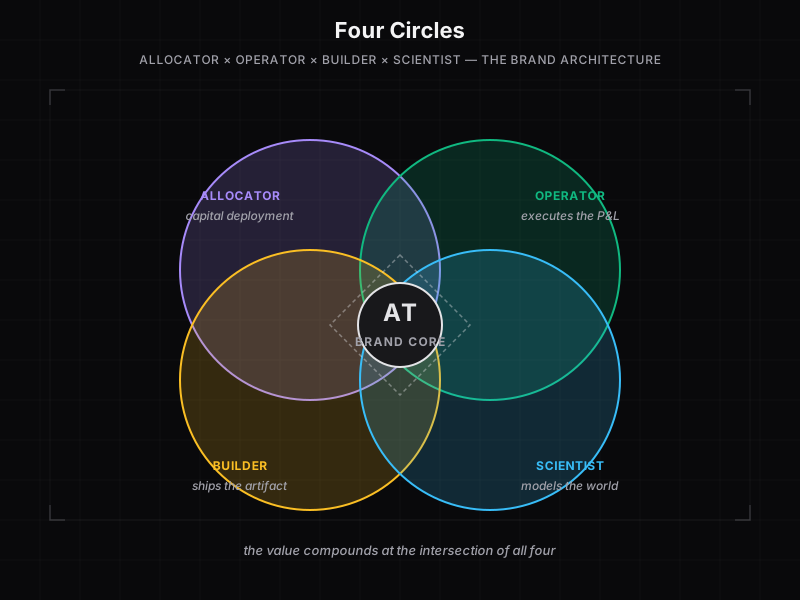
Allocator means M&A technical due diligence, portfolio construction, deciding which programs to fund and which to kill - not just building what someone asked for. Operator means $1B+ revenue, PE turnarounds, multi-brand portfolios, real P&L consequence. Builder means production systems at scale, solo full-stack delivery, code that runs in production rather than prototypes. Scientist means mathematical modeling, Bayesian decision frameworks, quantitative reasoning, and convergence arguments - the math that explains why the systems work.
What This Covers
Allocator + Operator
How P&L structures work as causal graphs, where value leaks, and what to build to capture it. PE-specific: turnarounds, multi-brand portfolios, M&A integration, and how to decide which programs to fund and which to kill.
Builder + Operator
When to automate, what it costs when the AI is wrong, and how to give it more independence without getting fired. Starts with the Verification Quadrant, prices errors with the Dollarized Confusion Matrix, and ends with the Promotion Protocol.
Scientist + Builder
How deterministic quality gates create gradient descent from stochastic AI output - the math behind quality ratchets and why they converge. Published as Quality Hillclimb with a working npm package.
Allocator + Scientist
Formal models for underwriting technical investments. The Templeton Ratio measures whether AI automation creates leverage or doubles the work. The Construction Spread prices the build-vs-buy decision before the first dollar is spent.
Get in touch
If you're interested in working together, or you found something in this work that doesn't hold up, write to me.
admin@templeton.hostElsewhere
Code on GitHub. Professional background and conversations on LinkedIn.