Stop writing improvement plans. Write a verifier.
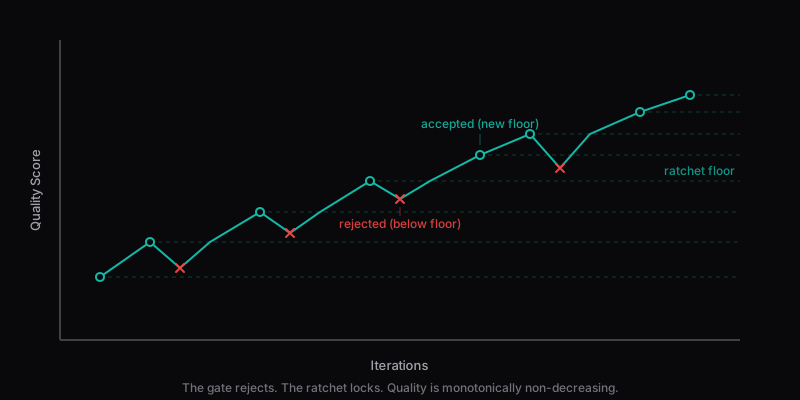
A cheap deterministic gate plus a floor that only rises turns stochastic agent output into monotone quality climb.
Drag to step through iterations. Iter 16/16: Accepted - floor rises (apex).
The Insight
AI agents produce stochastic output - given the same input, they generate different results each time. Most teams try to control this by writing better prompts, fine-tuning models, or adding instructions. This is playing the game.
Quality Hillclimb designs the game instead. The agent doesn't need a plan for improvement. It needs gates that create a one-way valve on quality. Output that passes the gate and exceeds the current best becomes the new floor. Output that fails is rejected. The agent tries again. Over many iterations, quality ascends.
How It Works
The Quality Ratchet
The Quality Ratchet is the primitive that makes hillclimbing possible. It is a CI-enforced floor that only moves up. Once a metric reaches a threshold, the system blocks any change that drops below it.
The ratchet is the mechanism that prevents downhill steps. Without it, the stochastic process is a random walk. With it, the stochastic process is a hillclimb.
Gate Design Principles
A good gate has three properties:
Quantitative and deterministic
The gate produces a number, and the same input consistently produces the same number. “Does it feel good?” is not a gate. “Does test coverage exceed 80%?” is a gate.
Cheap relative to generation
If the gate costs as much to evaluate as the agent costs to generate, you are back to T = 1 - the Verification Trap. The gate must be orders of magnitude cheaper than generation.
Correlated with actual quality
A gate that measures the wrong thing drives the wrong improvement. Goodhart's Law applies: when a measure becomes a target, it ceases to be a good measure. The gate must be validated against ground truth.
Why It Works: The Optimization Analogy
For readers who want the optimization analogy: this resembles stochastic search on a quality surface, without ever computing a gradient explicitly.
The mechanism is closer to rejection sampling than gradient descent - the gates provide a binary accept/reject signal, not a directional gradient. But the effect is the same: monotone ascent on a surface you rarely write down analytically.
Practical Example
AI agent writing code
Gate: tests pass + coverage >= current floor + linter clean + no security warnings.
Ratchet: each PR that passes and exceeds coverage becomes the new floor.
Result: over 100 PRs, coverage climbs from 60% to 85%. Lint violations drop from 200 to 12. Zero regression on any metric. No one wrote a “quality improvement plan.” The gates did the work.
Connection to Other Frameworks
Designed Convergence - Quality Hillclimb is the single-agent instance. The gates + ratchet are the conditions for convergence.
The Performance Frontier - the gates define what counts as “uphill.” The frontier is where the hillclimb is heading.
The Promotion Protocol - the autonomy graduation criteria are quality gates. The HITL state is a gate the AI must pass to earn autonomy.
Verification Quadrant - gates only work in the Sweet Spot where verification is cheap. The Templeton Ratio determines whether a gate is economically viable.
Worked example: the ratchet in a visualization grader
In practice, this framework shipped against 182 interactive visualizations scored on six rubric dimensions. No improvement plan was written. The agent was given a floor per dimension, a composite score, and the ability to re-run the grader. The instruction was: don't regress any floor, try to raise the composite.
Specifically, over a single color-expansion pass: concept_fidelity pass rate moved from 70% to 82% (+12pp) and pedagogical_scaffolding from 69% to 74% (+5pp). No one explicitly told the agent to improve concept fidelity. The ratchet made the hill it had to climb, and the agent climbed it. When visual_clarity barely budged (still at 28% pass), that was the next hill - it exposed a layout/text-size problem the color pass could not fix, and pointed the next iteration.
When the hillclimb breaks
The framework generates a falsifiable prediction: with cheap, reliable verification and a monotonic ratchet, average quality will rise without an explicit improvement plan. If it does not rise, one of the preconditions is wrong. The common failure modes:
- -Verifier is more expensive than the generator. If checking each attempt costs more than generating it, the ratchet economics flip and the hillclimb halts. Solve verification cost before installing the ratchet.
- -Goodharted rubric. A grader that is too legible invites optimization-against-the-proxy. The ratchet will climb, but the thing it climbs is not the thing you wanted. Counter with adversarial evaluation or held-out dimensions.
- -Local minimum. If every neighborhood move regresses at least one floor, the ratchet halts before the global optimum. Pair with periodic full-rewrite trials allowed to temporarily break the floor.
- -Ceiling from below the rubric. Sometimes the rubric itself tops out before the system is excellent (the visualization case hit a structural ceiling around 30% composite-pass). When that happens, change the rubric - the ratchet is doing its job, but the game is wrong.
Rosetta Stone
Four circles, four readings of the same object. Each role reads the artifact through its own lens.
The mechanism that turns a noisy producer into a monotonically improving asset. The ratchet is the covenant; the floor only goes up. The expected quality path has a non-negative derivative by construction.
How you run a team of agents the way you run a team of humans: set the standard, measure against it, promote what clears the bar, send back what doesn't. The gates are the manager.
Rejection sampling with a monotonic ratchet. Generate, evaluate, accept if above floor, reject otherwise. The floor rises with every accepted sample. The agent doesn't need a plan because the gates create ascent.
Monte Carlo maximization with a non-decreasing threshold. Under weak regularity conditions the sequence of accepted samples converges to the domain supremum. A martingale-adjacent construction that converts variance into progress.