Structured Elicitation
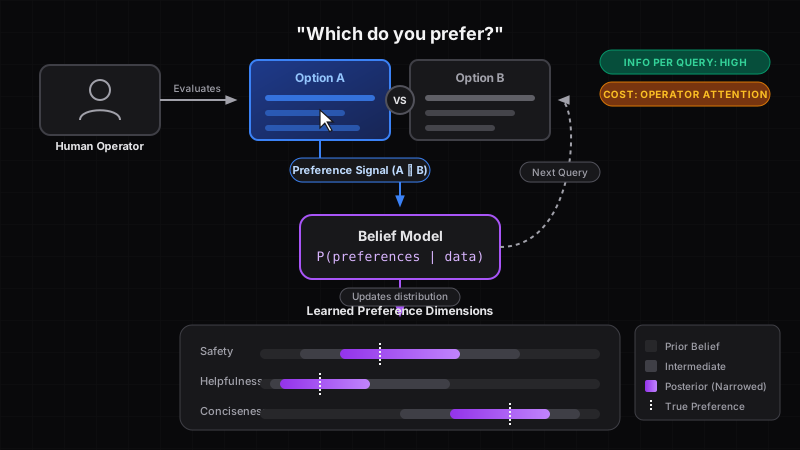
A controlled experiment designed to learn the operator's preferences. Pairwise comparisons, best-worst scaling, or adaptive conjoint analysis. Highest information per query of the three Deity Problem channels, but requires operator attention.
Why It Exists
Passive observation is cheap but noisy. Sometimes you need to design an experiment that asks exactly the right question - targeting the specific preference dimension where uncertainty is highest.
Rosetta Stone
Four circles, four readings of the same object. Each role reads the artifact through its own lens.
Targeted research spend. When observation is noisy, you design an experiment to ask the question that reduces posterior variance the most. Highest information per unit of operator attention.
The deliberate ask: "A or B?" "Pick your top three." Used when the default observation channel isn't enough and you need the reviewer to commit to a preference.
An adaptive conjoint or pairwise-comparison module wired into the product. Capture preferences with the lowest possible cognitive load.
A designed experiment, in the Fisher sense. Information gain per query is maximized by adaptive designs (e.g., D-optimality) that target dimensions where the posterior is widest.
Related Terms
Revealed Preference - Inferring the operator's preferences by watching what they actually do - not what they say they want.
Direct Query - A question posed to the operator, used only when the expected value of the answer exceeds the cost of the operator's attention.
Drift Detector - A posterior predictive check that detects when the operator's preferences have drifted from the learned model.
Frameworks & Tools
See also
Which bets to make. Capital allocation, M&A due diligence, portfolio construction.
How to execute at scale. Multi-brand portfolio, turnarounds, P&L ownership.
Builds it, ships it, owns it. Solo full-stack, DevOps, production systems.
Proves it, models it, publishes it. Mathematical modeling, Bayesian frameworks.
Structured Elicitation, Revealed Preference, Direct Query, Drift Detector