Capital Allocation
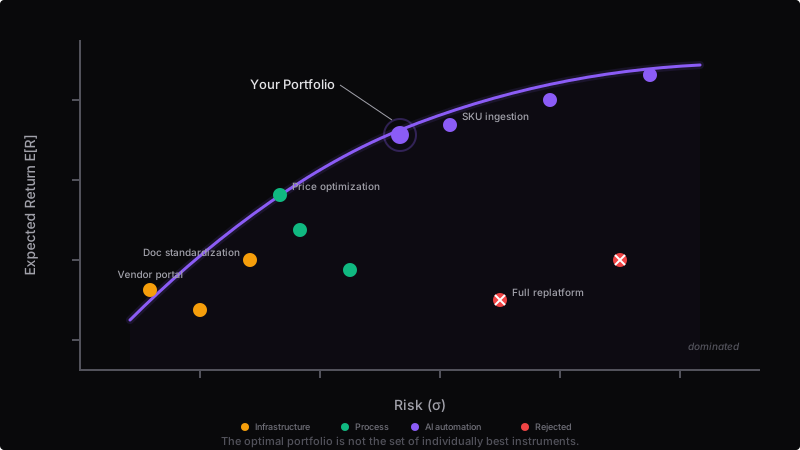
Every operating decision is a capital allocation decision. Each opportunity - an automation, a build, a hire, a process change - is an investment instrument with a return distribution. Most CTOs evaluate projects one at a time. That is a queue, not a portfolio. Portfolio construction means ranking by risk-adjusted return, mapping your tolerances, handling correlations, and selecting the combination that maximizes return for your level of risk.
The Problem
Standard corporate capital budgeting evaluates projects one at a time. Calculate NPV. Check the IRR against a hurdle rate. Accept or reject. Next project. This is how most technology organizations run their roadmaps.
That's not portfolio construction. It ignores correlations between projects, doesn't account for risk tolerance curves, and treats every investment as independent. Two projects with the same expected return but different variance get treated as equivalent. They aren't.
The Four Steps
1. Rank by Sharpe, Not NPV
E[R] / sigma(R). Two automations with equal NPV but different execution risk are not equivalent. Prefer the higher Sharpe when risk tolerance is moderate.
NPV tells you the expected return. Sharpe tells you the risk-adjusted return. The second is what you actually want to maximize.
2. Map Risk Tolerances
Low tolerance for market share loss this year? That is a left-tail constraint. Price it. Cash flow needs in Q3? That is a timing constraint. Capacity for only N simultaneous builds? That is a resource constraint.
Risk tolerances aren't preferences. They're constraints on which portfolios are feasible.
3. Handle Correlations
Two builds sharing the same team have correlated execution risk. If one slips, both slip. You can't sum their individual Sharpe ratios and call it a portfolio.
Technology dependencies, shared personnel, seasonal demand patterns - correlations hide in the operating context. Name them or they will surprise you.
4. Find the Efficient Frontier
The set of portfolios that maximize expected return for a given level of risk. Pick the point on the frontier that matches your risk tolerance curve. Deploy capital top-down.
This is Markowitz (1952) applied to operating investments. The math is the same. The inputs are different. Instead of stock returns, you have operating outcomes.
The Builder Advantage
Portfolio construction is only as good as your instrument models. If the return distributions are wrong, the frontier is wrong. And the single largest source of estimation error in operating investments is the cost side - how hard it is to build the thing.
A CTO who doesn't build has to rely on estimates from the team. Those estimates have high variance - optimistic when the team is excited, pessimistic when they are fatigued, systematically biased by anchoring to the last project. The cost side of the return distribution is wide.
A CTO who builds has a direct informational advantage. They know what a three-week project feels like because they have shipped three-week projects. The cost estimate has lower sigma. Lower sigma on cost means a tighter return distribution. Tighter distributions mean better portfolio construction.
Each circle contributes a necessary input to the allocation function. Remove any one and the portfolio construction degrades.
Where AI Fits
AI isn't the thesis. AI is a parameter shift in the instrument characterization step.
What AI did: shifted a large class of operating instruments from “not worth building” to “high Sharpe.” Tasks that had T ~ 1 (no leverage) now have T >> 1 (massive leverage). The menu of viable investments expanded.
When the set of investable opportunities is small, allocation is easy - fund everything viable. When the set expands, allocation becomes the bottleneck. You need to select from a much larger menu. This is why the allocation discipline becomes more important in an AI-enabled operating environment, not less.
The Five-Stage Allocation Cycle
This framework sits at Stage 3 of a five-stage cycle. The other frameworks and tools on this site cover the remaining stages.
Connection to Other Frameworks
Directed Graph - finds the mispriced edges. Capital Allocation ranks them and constructs the portfolio.
Knowledge Capital - determines which instruments are compounders vs wasting assets. The dual curve feeds the return distribution.
Construction Spread - the point estimate (risk-adjusted yield) of a single instrument. Capital Allocation extends this to full distributions and portfolio-level optimization.
Automation NPV - models the economics of an individual instrument. Capital Allocation uses these as inputs to portfolio construction.