Quadrant Shifting
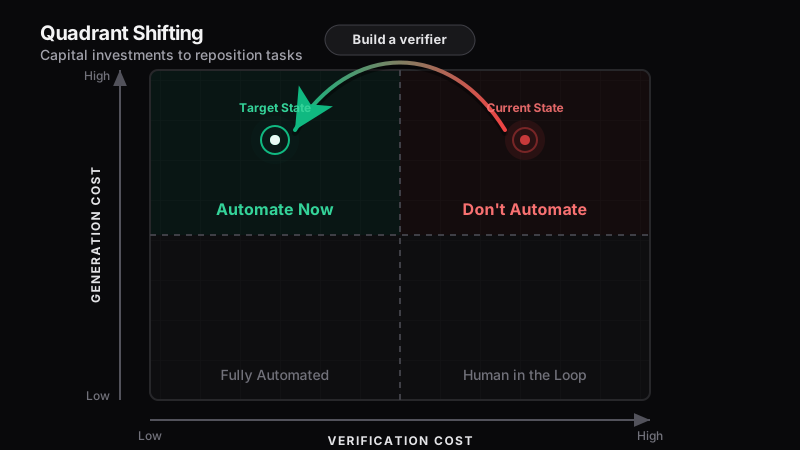
Capital investments that move a task to a better position on the Verification Quadrant. Five moves: build a verifier, decompose the task, enrich inputs, constrain outputs, build a rubric.
Why It Exists
The quadrant isn't destiny. If you can build a verifier that makes verification cheap, a task that was "don't automate" becomes "automate now." That verifier is a capital investment with compounding returns.
Rosetta Stone
Four circles, four readings of the same object. Each role reads the artifact through its own lens.
CapEx for OpEx leverage. Spend once on a structural intervention; the task occupies a more profitable cell forever after.
The move where you invest in tooling so next quarter's version of the same decision is cheaper. Gets the team out of the "we always do this by hand" trap.
Build the verifier, decompose the task, enrich the inputs, constrain the outputs, build the rubric. Each move shifts cell membership.
A structural intervention that changes the task's position in the cost-space partition. Formally: a change of measure that re-indexes the task into a different quadrant.
Related Terms
AI Sweet Spot - A task where generation is hard but verification is cheap.
Verification Trap - A task that is easy to generate but hard to verify.
Construction Spread - S = (annual_value x P(success)) / build_cost.
Frameworks & Tools
See also
Which bets to make. Capital allocation, M&A due diligence, portfolio construction.
How to execute at scale. Multi-brand portfolio, turnarounds, P&L ownership.
Builds it, ships it, owns it. Solo full-stack, DevOps, production systems.
Proves it, models it, publishes it. Mathematical modeling, Bayesian frameworks.