Verification Trap
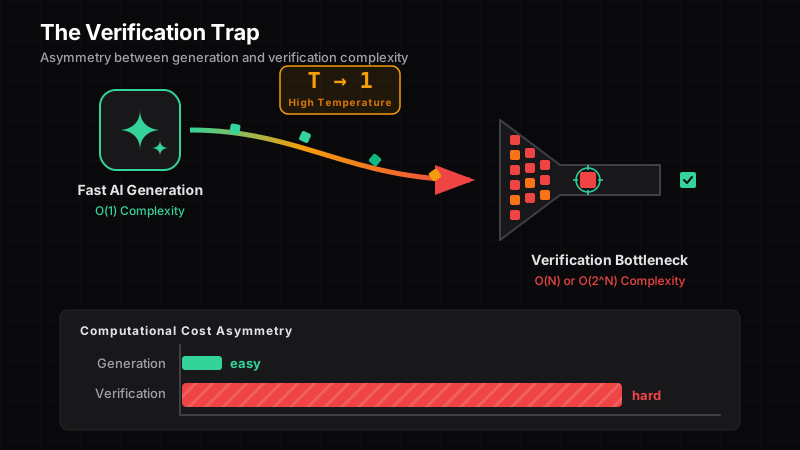
A task that is easy to generate but hard to verify. The AI produces output effortlessly, but checking whether it is correct takes as long as doing it manually. T approaches 1.
Why It Exists
A common failure mode in early AI deployments - frequently more damaging than technical limitation. The task looks automatable because generation is easy. But "is this output correct?" scales linearly with volume.
Rosetta Stone
Four circles, four readings of the same object. Each role reads the artifact through its own lens.
An instrument that looks automatable on paper because unit cost of generation collapsed. The trap is that unit cost of verification scales linearly. Net NPV is often negative despite dazzling demos.
The AI that makes the team's work look faster until review week, when the reviewers realize checking the output is as slow as doing it ever was.
The automation that produces output by the thousand but each output needs a human to bless it before it ships. Throughput is bounded by the humans; you added cost without adding throughput.
A task where generation cost collapsed but verification cost didn't. Per-output verification still scales linearly with volume, so the asymmetry that makes automation profitable is absent.
Related Terms
Templeton Ratio - T = time_to_do / time_to_check.
AI Sweet Spot - A task where generation is hard but verification is cheap.
Quadrant Shifting - Capital investments that move a task to a better position on the Verification Quadrant.
Frameworks & Tools
See also
Which bets to make. Capital allocation, M&A due diligence, portfolio construction.
How to execute at scale. Multi-brand portfolio, turnarounds, P&L ownership.
Builds it, ships it, owns it. Solo full-stack, DevOps, production systems.
Proves it, models it, publishes it. Mathematical modeling, Bayesian frameworks.
Verification Trap