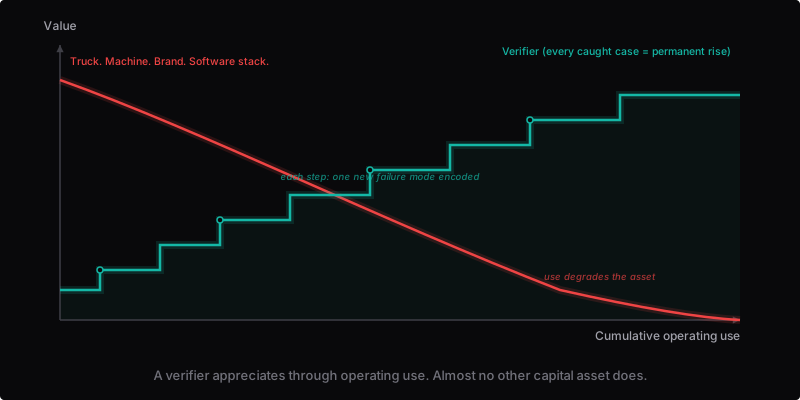
Stop expensing your QA. You are building an appreciating asset and booking it as cost.
Every failure a verifier catches gets encoded, and the next run inherits the catch - so your NPV must credit the appreciation term, not just the per-unit savings.
Drag along the chart to scrub operating use. Verifier value 45, other-asset value 42.
Why a verifier is a rare class of capital asset
The standard finance model assumes capital assets decay through use. That is why depreciation schedules exist. Trucks, machines, factories, software stacks, even brand equity - the longer you run them, the more maintenance and renewal capital they consume.
A verifier inverts the schedule. Every time it sees a real output, one of two things happens. Either it accepts (no change) or it catches a failure - and the corrected failure mode gets encoded into the verifier as a new rule, a new test case, a new rubric line, a labeled adversarial example. The next run inherits that catch. The catch is durable; the floor moved up.
Run the verifier ten thousand times against ten thousand different inputs and you have ten thousand chances to catch a novel failure mode. Most don't fire, but the ones that do are permanently encoded. The asset gets better through operation. Through operation, not in spite of it.
Depreciate with use
- ↓Trucks, machines, factories - every mile, cycle, or shift adds wear
- ↓Software stacks - distribution shift, API churn, dependency rot
- ↓Brand equity - decays without renewal; use without quality erodes it faster
- ↓AI models - distribution shift and competitive erosion; the prompt rots
Appreciate with use
- ↑Verifiers - each failure caught is encoded; the floor only ratchets up
- ↑Labeled corpora - every run becomes a labeled example or a flagged edge case
- ↑Institutional rubrics - judgment codified once, applied infinitely
- ↑Process knowledge - where failures cluster is cumulative information
The precedent: Wright's Law
None of this is a new claim about how assets behave. In 1936, studying airframe production, the engineer T. P. Wright measured a regularity that has held across aircraft, semiconductors, solar panels, and batteries ever since: unit cost falls by a fixed percentage every time cumulative volume doubles. The improvement tracks units produced, not calendar time. It is the learning curve, and one of the oldest and most durably validated results in manufacturing economics.
A verifier is the same shape with one extension. Wright's Law is about cost: make more, and each unit gets cheaper. A verifier's per-check cost does fall that way, the fixed build cost amortizing toward zero as you run it over more output. But the verifier also appreciates, which the classic curve does not. Wright's improvement lives in the process and has to be re-earned by the next factory; a verifier's improvement is banked in the asset, because every caught failure is durably encoded. The cost half is ordinary learning-curve economics, ninety years established. The value half, the floor ratcheting up rather than the cost ratcheting down, is what makes the verifier a rare capital asset instead of a routine one.
The two claims even fail the same way. A learning curve that flattens after a few doublings falsifies the cost claim; a verifier whose accuracy stops improving as its corpus grows falsifies the value claim (see below). Borrowing the older law's structure is deliberate: it puts the appreciation claim on measured ground and hands it a falsifier of the same shape, instead of asking you to take the inversion on faith.
The Quadrant Shift Mechanic
Beyond appreciation, a verifier does something operational that almost nothing else does: it permanently moves a task across the Verification Quadrant.
Tasks in the quadrant are positioned by two coordinates: difficulty to generate and difficulty to verify. Build a verifier that makes verification cheap, and the task drops downward on the diagram. What was "hard to verify" becomes "easy to verify."
- →A task stuck in Do Not Automate drops into the AI Sweet Spot.
- →A task trapped in the Verification Trap drops into Automate Now.
- →The shift is structural and permanent. The verifier becomes part of the task; the task lives in its new quadrant forever.
See Quadrant Shifting for the full set of moves; building a verifier is the highest-leverage one.
The Investment Math
Building a high-quality verifier is often harder than building the generator. It requires deep domain knowledge, careful rubric design, and usually a blend of deterministic checks and calibrated scoring. It is not cheap to build.
But once the verifier exists, every unit of AI output can be checked at near-zero marginal cost, and the entire task permanently moves quadrants. That is the trade: one-time capital expenditure against a structural change in operating economics.
Suppose hand-checking one output costs roughly $4 and the verifier checks the same output for about $0.05, on a line running on the order of 10,000 outputs a month. The monthly saving is about (4 − 0.05) × 10,000 ≈ $39,500, so a verifier that cost roughly $60,000 to build pays back in under two months on the savings term alone - before crediting any appreciation. The figures are round illustrative inputs, not a measured case; the structural point is that payback is short whenever verification is far cheaper than generation and the volume is real.
The Automation NPV tool models both the per-unit savings and the appreciation curve. Skip the second term and the NPV is structurally wrong - the verifier is being valued as a depreciating asset.
What counts as a verifier
A verifier is any system that cheaply and reliably checks whether an output is correct. The term covers a wide span - what matters is the asymmetry: generation is the load-bearing work, verification is the cheap check that keeps the generation honest.
The Investment Implication
The companies winning at AI aren't the ones picking the easiest tasks. They're the ones building verifiers that increase their Templeton Ratio - making hard tasks easy to check, then running those tasks at scale.
The generator is the truck. Replaceable. Depreciating. The model is commodity within months. Don't build custom generators unless the verifier you wrap them with justifies it.
The verifier is the land under the depot. Distinctive. Compounding. Increasingly expensive for a competitor to replicate. Each adversarial case you encode is one your competitor still has to discover.
When two firms run the same generator on the same task with the same volume, the one with the better verifier captures more value - and the gap widens with use. That is the structural mispricing this framework targets.
When verifier-capital fails
The framework makes a falsifiable prediction: a well-built verifier appreciates monotonically against a growing corpus of real operating runs. If observed verifier accuracy does not improve as the corpus grows, the classification is wrong for that system.
- -No encoding step. If caught failures are not durably recorded - added to the rubric, baked into a test, labeled in the gold standard - the appreciation never lands. You have a review process, not a capital asset.
- -Verifier cost equals or exceeds generator cost. The framework assumes the verifier is cheaper to run than the thing it grades. When that fails, you have two generators running in tension, not a check on one of them.
- -Rapidly shifting task definition. If the task itself mutates faster than the verifier accumulates rules, old encoded failures go stale and the floor drops. The corpus depreciates.
- -No adversarial pressure. If the verifier never actually catches anything because the upstream generator is always correct, you have a smoke detector with no fire. The verifier is not appreciating; it is just sitting there.
Rosetta Stone
Four circles, four readings of the same object. Each role reads the artifact through its own lens.
A capital asset with an unusual property: it appreciates through operating use. Most operating instruments depreciate; the verifier ratchets up because every caught failure is a new encoded rule. Reprice the verifier line accordingly - the NPV that treats it as a wasting asset is structurally too low.
The thing that lets you put AI on a hard task and keep it on. Every adversarial case the verifier catches becomes a new test the next run has to clear. Operating use compounds your safety margin instead of eroding it. Build the verifier before you scale the volume.
A test suite that grows with production traffic. Every caught regression gets pinned. CI floor only moves up. The verifier is the highest-leverage code asset in the system because every other line depreciates and this one does not.
A monotonically growing classifier of acceptable outputs, updated by adversarial examples drawn from the operating distribution. Coverage approaches the true accept region asymptotically; the rate of approach is the appreciation curve.