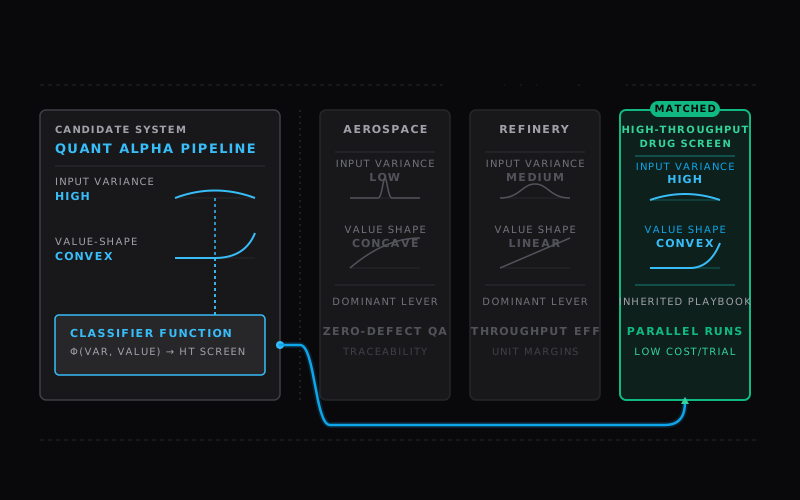
Stop inventing operations. Name your line's signature and inherit a mature industry's playbook.
Coarse input, output kind, and risk curvature propose the analogy; aerospace, refinery, and high-throughput screen share reliability and process control but optimize for entirely different things.
A repeatable knowledge-work line - one stable enough to define inputs, transforms, outputs, and defects - can be operated like a factory. The comparison only earns its keep if it tells you which kind, because aerospace, an oil refinery, and a high-throughput drug screen have very different dominant operating levers (they share reliability, process control, and quality documentation, but optimize for entirely different things). The working claim:
Not injective and not calibrated - the signature proposes analogies; it does not determine an archetype.
Name your line's signature and a mature industry's operations playbook becomes a head start you can borrow selectively - never wholesale, and only where the constraints match (assayability, defect observability, stationarity, marginal cost, queueing, regulatory burden). The richer the set of archetypes you can recognize, the more candidate practice is available. Try the interactive classifier to place your own line. Low-repeatability work - exploratory research, negotiation, bespoke strategy, incident response - is where the analogy fits worst: the diagnostic should abstain, and the right move is to stabilize or decompose the work into a repeatable line first (or use a different lens), not to force an archetype onto it.
The signature
The diagnostic asks six primitive coordinates - input (I), output kind, and the shape of the value out (U). The process (Σ) is only proxied by risk curvature and otherwise checked by follow-up questions, not directly asked. These are exactly the questions the tool asks - one canonical schema. They underdetermine the operational form, so the output is a candidate, not a verdict: two lines can share all six and still differ on regulation, defect latency, or human-review cost.
Derived consequences (implied, not asked)
Worked example (illustrative)
Take a line that turns scanned vendor invoices into structured fields. Name its six coordinates: low-grade abundant input (free incoming PDFs), extreme input variance (most of each page is irrelevant, a few fields are load-bearing), a data-slate output, concave risk curvature (a wrong field is costly and breadth of attempts does not help), a reusable extraction recipe, high volume.
That signature points at a refinery: continuous processing of a low-grade feed into a purified stream. So the playbook to borrow is statistical process control on the output fields plus a cheap pre-filter on the feed - not the breadth-of-attempts screening a convex discovery line would want. The point is the method, not this particular line: name your six coordinates, read off a candidate, then verify it against where your defects actually land.
When the middle is commoditized, value often migrates to the ends
Use this only if cheapening the middle does not degrade risk-adjusted, end-to-end quality - which includes latent defect rates, compliance/audit exposure, security, model drift, reversibility, and accumulated learning, not just externally-visible metrics (those lag, and the middle is exactly where hidden liabilities surface later). If cheapening it hurts any of those, the middle is your moat - invest there instead.
In many scalable, content- or software-like lines, value added per stage traces a smile once the middle is commoditized: high at the design end (the reusable recipe, the schema, the judged template) and the distribution end (the published surface, the demand-capture page), low in a commodity middle engineered cheap so the line scales. The conditional matters - in plenty of lines the middle is the moat (regulated processing, proprietary data cleaning, latency-sensitive infrastructure, expert review). The diagnostic question is whether your risk-adjusted, end-to-end quality - including latent and delayed liabilities (defect rate, compliance/audit debt, security, drift, reversibility, learning loss), not just externally-visible output - stays stable when the middle is cheap; if it does not, invest in the middle.
Make-vs-buy is a separate decision, not something that falls out of the curve. Buying commodity perception (extraction, model inference, raster generation) is often the first hypothesis to test, but the boundary turns on transaction cost, asset specificity, hold-up risk, IP leakage, latency, reliability, and whether the component compounds learning - and markets can sometimes sell you the join via integrators or managed services. When the middle is genuinely commoditized, the allocation read is own the left-end recipe and the right-end surface, minimize ownership of the middle - and the operator who owns both ends is better positioned to capture the rent, subject to bargaining power, switching costs, rights, and channel dependency.
The archetype zoo
This is the current working set of archetypes - the ones that have covered the small, internal sample of lines analyzed so far (the sample is biased toward the kinds of lines I have built, and the negative cases are not yet catalogued). The falsifiable bet is that the set stays small as the sample grows; the honest invitation is for counterexamples. A line resembling professional services, marketplace governance, education, clinical care, or trust-and-safety may not fit cleanly - if yours does not, that is a new-archetype candidate, not a forced label. Tap one to read what its playbook transfers, and what does not.
Vertically Integrated Process Chain
Physical exemplar: a specialty-chemicals firm running discovery, pilot, and production under one roof
Not one factory but several wired in series, with a risk-curvature sign-flip mid-line: convex discovery searches for a recipe, then concave production runs it at scale.
Apply the right QC regime per layer, not per line. Screening metrics on the convex discovery layers; statistical process control plus cost-weighted thresholds on the concave production layers. A uniform posture across a chain is the common mistake.
- →Theory of Constraints across the whole chain - the irreducible-judgement review tier is often (not always) the drum; instrument throughput where the bottleneck actually is.
- →Consider an inter-stage buffer at the curvature sign-flip (the joint between discovery and production), where queueing variance tends to concentrate.
- →Run the full ops stack per layer, not uniformly: screening economics upstream, SPC and poka-yoke downstream.
- →Treat the discovery half and the production half as separately fundable subsystems with an explicit handoff contract.
Stage-specific QC, inter-stage buffering, and constraint analysis across a multi-stage line.
Buffer/gate/firm-boundary placement is not mechanically fixed by the sign-flip; observability and defect cost can move them.
When the line is a chain, apply QC per layer
In the lines I have analyzed, the most common pattern is not one factory but a chain with a risk-curvature sign-flip in the middle: a convex discovery stage that searches for a winning recipe, feeding a concave production stage that runs it at scale. (Pure-convex search lines and pure-concave execution lines exist too - the tool classifies those without forcing a chain.) The discovery half wants screening economics - many cheap shots, gold-plate only the confirmation, measure cost-per-confirmed-hit. The production half wants the opposite - statistical process control, cost-weighted thresholds, poka-yoke interlocks.
Where a line is a chain, a uniform QC posture across it is the common mistake. The most useful move is to find the sign-flip - the stage where you stop screening for upside and start defending against downside. It is a strong candidate location for your inter-stage buffer, your strictest gate, and your make-vs-buy boundary - but verify against where defects are actually cheapest to detect, where irreversible cost lands, and where queueing concentrates; any of those can pull a gate or boundary off the joint. When your curvature is mixed the classifier proposes a chain decomposition - but only after you confirm both halves are genuinely load-bearing; if one stage dominates with a light prelude, it points you to classify the dominant stage instead. A sign-flip exists is not the same as the chain is the dominant archetype.
The Formalism (work in progress)
Is the analogy a theorem or a metaphor? The dense page treats the structural functor honestly: what an adversary forced us to walk back, where the category theory is decorative, and the one open program - a computable obstruction invariant - that would make it predictive. Read it for the rigor, not for the playbook.
Changelog6 entries · building in publicshow ↓
- Adversary round 8 (gpt-5.6-sol). Removed the self-contradiction in the smile-curve gate (the diagnostic test is now risk-adjusted end-to-end quality, not "externally-observable quality"); aligned the non-repeatable-work guidance with the tool (abstain and stabilize/decompose, do not generate a hypothesis result); annotated the formula that the process coordinate is only proxied; softened "buying commodity perception is usually right" to "often the first hypothesis."
- Adversary round 5 (gpt-5.6-sol). Broadened the smile-curve gate from "externally-observed quality" to risk-adjusted end-to-end quality (latent defects, compliance, security, drift, reversibility, learning - lagging metrics are insufficient). Made the chain copy conditional: mixed curvature proposes a chain only after both halves are confirmed load-bearing.
- Adversary round 4 (gpt-5.6-sol). Softened the last universals (risk curvature is "usually" the strongest signal); sharpened the foundry exemplar to a semiconductor fab and removed turbine-blade machining from the bespoke aerospace row (it is a qualified repeatable process). The classifier now resolves the six-coordinate collisions via an answerable follow-up rather than disclosing them as dead-ends.
- Adversary round 3 (gpt-5.6-sol). Made the smile curve conditional in the heading and the diagram (with a "use only if cheapening the middle does not hurt quality" gate); softened universal input-screening claims to conditionals; "very different operating levers" rather than "almost nothing in common"; tied playbook transfer to matching constraints; annotated the formula as non-injective (proposes analogies, does not determine); reworked the make-vs-buy derived row.
- Adversary round 2 (gpt-5.6-sol). Scoped "knowledge work is manufacturing" to repeatable lines; reconciled the signature to one canonical six-coordinate schema (primitives vs derived consequences); made the smile curve and "starve the middle" conditional (the middle can be the moat); separated make-vs-buy from the curve; relabelled the zoo a "current working set" inviting counterexamples; made the sign-flip a candidate location, not a law.
- First public draft of the conceptual explainer: triple signature, archetype zoo, smile curve, make-vs-buy boundary, per-layer QC doctrine.
Rosetta Stone
Four circles, four readings of the same object. Each role reads the artifact through its own lens.
The recipe for which physical industry to underwrite your knowledge-work line as. Own the left-end recipe and the right-end demand surface; starve the commodity middle. That is the allocation thesis stated as a value-add fact.
A way to stop running every line the same way. Most lines are chains with a curvature sign-flip; apply screening economics upstream and statistical process control downstream, never one posture across the whole thing.
The system-design prior. The signature tells you whether you are building a screen, a refinery, a configurator, or a shared substrate - and therefore which failure modes to engineer against first.
A typology archetype = f(I, Σ, U) with a falsifiable compression claim and a separate, honestly second-class categorical track (a structural functor with an open obstruction-invariant program).