Any Sufficiently Advanced Technology: A Taxonomy of Magic
See the ideas in motion
AlphaShort narrated scenes. Open one here, or follow it in a full window.
A 6-step protocol sorts the winners from the losers in technology transitions. I ran it across 6 transitions spanning ~700 years - from double-entry bookkeeping in the 1300s through the internet. Every cell fills. Then I applied it to LLMs.
This post gives you the protocol and proves it on one transition in full. Then it sketches what the protocol predicts for LLMs and names the specific questions you should be asking about your own business. The Eighth Ledger: When Intellectual Labor Becomes a Capital Asset runs the protocol across five more historical transitions to stress-test the pattern.
The protocol started with a question about magic.
Every generation encounters a technology that feels like magic. LLMs are ours. But “it feels like magic” isn’t useful. The useful question is: what specifically makes a technology feel like magic? Because the answer turns out to be structural - and the structure predicts who profits and who doesn’t.
Three Kinds of Magic
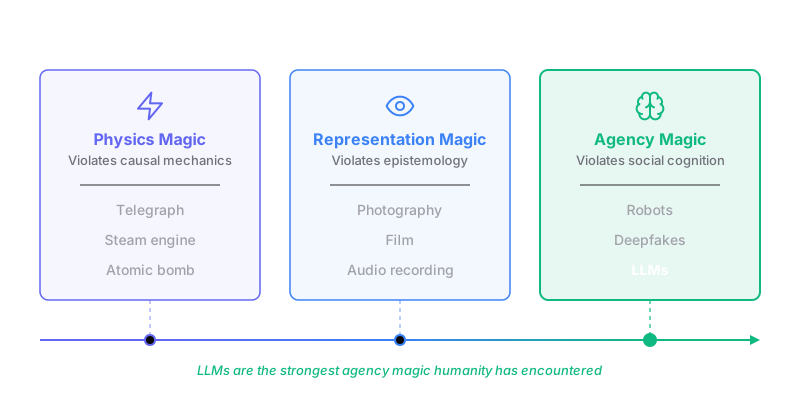
“Magic” is what happens when an artifact violates the implicit rules a mind uses to predict the world. Different technologies break different rules. There are three distinct categories.
Physics magic violates causal mechanics - how matter, energy, and information are supposed to behave. Telegraph: information outruns the fastest horse. Radio: a signal crosses the air with no wire at all. X-rays: you can see through flesh. Each breaks a physical intuition.
Representation magic violates epistemology - how evidence and authenticity are supposed to work. Photography: the world writes itself onto paper without a human hand. Film: the dead move again. Audio recording: your voice outlives you. Each breaks the link between evidence and presence.
Agency magic violates social cognition - how minds and intentions are supposed to work. Robots: motion without life. Deepfakes: identity without person. LLMs: language without a mind, but language that still triggers every mind-detection instinct you have.
LLMs aren’t the strongest physics magic humanity has encountered. They’re the strongest agency magic. That’s why they land differently than anything before them.
The Timeline: Rules Broken, Not Inventions Made
The interesting way to read a technology timeline isn’t “cool things humans built.” It’s “which implicit rule did this break?”
| Era | Technology | Rule Broken |
|---|---|---|
| ~1440 | Printing press | Scalable text without scribes - authority becomes reproducible |
| ~1608 | Telescope | The heavens become inspectable, not just received |
| ~1676 | Microscope | Invisible life exists below perception threshold |
| ~1780 | Steam engine | Force without muscle - matter has agency |
| 1844 | Telegraph | Information outruns bodies |
| 1839-1860s | Photography | Reality writes itself - no human hand required |
| 1895 | Radio | A signal arrives with no wire at all |
| 1895 | X-ray | Sight penetrates opaque matter |
| 1927 | Television | Remote presence - be somewhere you’re not |
| 1945 | Atomic bomb | Energy density reaches godlike scale |
| 1969 | Moon landing | The sky is navigable, not just observable |
| 1991 | World Wide Web | Global mind-mesh - collective cognition at distance |
| 2007 | Smartphone | Omniscient oracle in your pocket (GPS from 2008) |
| 2022 | LLMs | Fluent language without a mind behind it |
| 2024+ | Synthetic media | Reality itself becomes editable |
Each entry marks the moment an implicit assumption about how the world works stopped being true - the moment a rule you relied on no longer held.
But timelines only tell you what happened. They don’t tell you who won.
The Protocol: 6 Steps That Predict Winners and Losers
Every technology transition in the timeline above follows the same structural pattern. I’ve distilled it into six steps. Each step is a specific analytical move with a specific output. Together, they form a protocol for navigating any paradigm shift.
1. DECOMPOSE - Identify the specific friction that collapsed. Not “new tech is powerful” but “the cost of X dropped N-fold.” The friction is never monolithic - decompose it into components. Some components collapse, others don’t. The component-level view is what separates useful analysis from panic.
2. INVERT - Instead of asking “how does this affect me?” (which invites motivated reasoning), ask: “What would have to be true for me NOT to be affected?” Then honestly test those conditions. This is the sharpest tool in the protocol.
3. COMPLEMENT - When one resource becomes abundant, its complement becomes scarce. Physical labor abundant -> design scarce. Distribution free -> attention scarce. Find the new scarcity. That’s where value concentrates.
4. MIGRATE - In every transition, value moves from execution to orchestration. The person who does the work loses margin. The person who designs the system that replaces the work captures it. Map where value moves in your specific chain.
5. RECALCULATE - When the cost of an action drops 10x, so should your bet size move the other way: on a fixed budget you could afford on the order of 10x as many attempts (the exact optimum depends on the payoff distribution; the load-bearing point is the direction). But intuition anchors on old costs. So you systematically under-invest in the newly-cheap action class. Recalculate your bet sizes.
6. TIME - The alpha in every transition is speed of adoption, not speed of prediction. By the time conservative actors have enough evidence to move, early adopters have compounding advantages that are nearly impossible to close.
Those are the steps. But a framework without evidence is just a story. Let me show you it works.
The Printing Press: All 6 Steps
In 1440, Gutenberg’s press broke a rule: text no longer required scribes. The protocol applied in full:
DECOMPOSE. The friction was reproducing text by hand. A scribe produced a few pages a day. An early press produced on the order of a few thousand - a collapse of roughly three orders of magnitude. But the friction wasn’t monolithic. It decomposed into four components. Physical reproduction of text: collapsed ~1,000x. Illumination and decoration: untouched - the press can’t do gold leaf. Authentication and legal witnessing: untouched - requires physical presence. Editorial selection of what to reproduce: became more valuable, not less.
Scribes who understood their friction at the component level survived. The ones who thought their value was “writing” didn’t.
INVERT. “What would have to be true for scribes to be unaffected?” Mechanical reproduction would have to produce inferior output that buyers reject. For plain text: the inversion fails immediately - press output was actually cleaner than hand-copying. For illuminated manuscripts: the inversion holds - the press can’t replicate artistry. For legal documents: the inversion holds - witnessing requires a human.
Most scribal revenue was plain text, not luxury illumination or witnessed legal work - very likely the large majority of the market. The inversion fails for that bulk of demand. The point isn’t the exact share; it’s the direction: the commodity core is exposed, the artistry and the witnessing are not.
COMPLEMENT. Text reproduction becomes abundant. What becomes scarce? Initially, literacy itself - it took generations for readership to catch up with production capacity. Then: editorial judgment (what’s worth printing), original authorship (writing is now the scarce input to an abundant production system), distribution networks (getting printed material to readers), and verification (is this text authorized?).
The Stationers’ Company in London captured the verification scarcity and turned it into a regulatory moat. They understood complements before the word existed.
MIGRATE. Value moves from the copyist (execution) to the publisher (orchestration). The publisher selects what to print, manages the press, handles distribution. Within 50 years, the major economic actors in text are publishers, not scribes. Secondary migration: authors gain leverage, because their unique content is the scarce input to an abundant reproduction system.
The same migration that would repeat for 600 more years: execution -> orchestration.
RECALCULATE. Before the press, only texts with guaranteed large demand justified reproduction (Bible, Aristotle, legal codes). The cost per title was so high that you couldn’t afford to bet on marginal works. After the press, speculative publishing becomes rational. Pamphlets, controversial tracts, niche scientific works - all become economically viable.
The Protestant Reformation was partly a Kelly recalculation. Luther’s 95 Theses were economically viable to mass-distribute because the press made the per-unit cost of a bet on an unproven text trivially small. The old cost structure would never have funded it.
TIME. Venice and Mainz became early printing centers and captured outsized cultural and economic influence for centuries. The Aldine Press in Venice (founded 1494) moved fast and standardized formats. The italic type and the pocket-sized octavo editions, both around 1500-1501, were the bet: fix the format, and the format becomes the moat. It built institutional advantages that lasted generations. Cities and empires that banned or restricted printing fell behind in knowledge accumulation - some by centuries.
The Pattern
That’s one transition. Every cell fills. Every cell predicts something specific and testable.
I ran this protocol against five more transitions: limited liability (1850s), the assembly line (1910s), containerization (1956), the internet (1990s), and double-entry bookkeeping (1300s). In every case, all six cells fill. The pattern holds.
The protocol predicted that luxury craftsmen survive the assembly line but commodity craftsmen don’t (INVERT). It predicted that attention and curation become valuable when distribution is free (COMPLEMENT). It predicted that ports committing early would gain durable advantages after containerization (TIME). Port Newark/Elizabeth is the case: McLean’s first container ship sailed there in 1956, and it pulled cargo from New York’s older finger-piers. Singapore’s 1969 bet on a container terminal made it a regional hub. It predicted, too, that the professional management class would emerge once limited liability let corporations raise diffuse equity at scale. Two forces, one mechanism: cheap risk-bearing (COMPLEMENT) plus the coordination demands of large enterprises (MIGRATE).
Six transitions. 36 cells. Each one carries a specific, falsifiable claim - though fitting six cases I chose is consistency, not proof. The real test runs forward. The LLM transition below is the one prediction still open.
Now Run It on LLMs
LLMs break the deepest link in the agency category: language implies mind. We spent hundreds of thousands of years learning that rule. Photography broke “image implies artist.” Film broke “motion implies life.” LLMs break “language implies mind.” And language is the one we’re most wired to trust.
That’s why they feel like magic. But structurally, LLMs are just another friction collapse. The protocol applies. The sketch:
DECOMPOSE. The friction is the marginal cost of intellectual output production - text, analysis, classification, code, translation. It drops 10-100x. But the friction decomposes. Product categorization: fully automatable. Contract review: clause extraction collapses, but risk judgment doesn’t. Customer support: first-response collapses, but escalation doesn’t. The businesses that navigate this will be the ones that decompose their knowledge work into components and see which parts collapse and which don’t. Exactly like the scribes.
INVERT. “What would have to be true for your expertise-as-a-service business to be unaffected?” Your output would have to be so distinctive that automated output can’t substitute. Customers would have to value the relationship, not the deliverable. Regulation would have to mandate human-produced work. Test those conditions honestly. For commodity legal review, boilerplate analysis, template-driven consulting: the inversion fails. For contextual advisory, relationship-based sales, regulatory-mandated oversight: it holds. Most businesses have revenue streams in both categories. The inversion test tells you which are exposed.
COMPLEMENT. Intellectual output becomes abundant. What’s scarce? Context (your proprietary data, not the generic model). Judgment (knowing what to produce and when to override the machine). Orchestration (designing production systems, not executing tasks). Accountability (when anyone can generate plausible text, the human who stands behind it appreciates in value). These are the new strategic assets.
MIGRATE. Value moves from the analyst who produces reports to the architect who designs reporting pipelines. From the writer to the editor. From the coder to the system designer. Execution to orchestration - the same migration as every prior transition. The pipeline becomes a capital asset. Intellectual labor gets capitalized the same way the assembly line capitalized physical labor.
RECALCULATE. Building a custom AI pipeline still costs real money. But the model layer is what collapsed - inference and API prices have fallen by orders of magnitude since 2023, so the compute-and-iteration portion of a build is a fraction of what it was. When a trial gets an order of magnitude cheaper, the evidence threshold for “should we try” falls by roughly the same order. Most companies still treat AI experiments as scarce, staffed projects and run very few. When the per-trial cost collapses, the rate at which you should run them rises sharply. But you’re still sizing your experimentation budget on the old, expensive cost of a trial. (This is the spirit of Kelly - bet more aggressively as your edge-to-cost ratio improves - used as an analogy, not a literal Kelly fraction: Kelly outputs a bet size from edge and odds, not a count of experiments.)
TIME. We’re at roughly “1997 internet.” The technology is real. Most companies haven’t built their pipelines. Each pipeline you build teaches you how to build the next one faster. Historical pattern: in the markets where it holds, an early-mover edge can persist for years. But the duration is variable and conditional (network effects, switching costs, accumulating proprietary data), and plenty of first-mover advantages erode as fast followers free-ride on the market education. The bet is that the AI-operations edge is the durable kind, not that early movers are automatically safe. Where the edge does compound, 12 months of delay isn’t just foregone savings - it’s the gap that keeps widening.
What Breaks Next
The protocol also predicts forward. Not by guessing technology, but by asking which frictions haven’t collapsed yet.
Persistent agents with real-world actuation. Agency magic, but with consequences. When LLMs book flights, move money, and negotiate contracts, the agency violation jumps from “it talks” to “it acts.” Friction collapse: cost of coordinated action.
Robust synthetic media. Representation magic at its terminal form. Synthetic video where “footage as evidence” ceases to function. Friction collapse: cost of producing convincing evidence.
Brain-computer interfaces. The first technology to violate rules about the self. When thoughts route through external hardware, the boundary of “you” becomes negotiable. Friction collapse: cost of cognitive augmentation.
Each is analyzable through the same 6 steps. Each will have the same pattern of friction collapse, inversion failures, complementary scarcities, value migration, Kelly recalculation, and adoption speed advantages.
The printing press was magic. Then it was infrastructure.
LLMs are magic now. Sure. But the pattern this protocol traces - friction collapses, value migrates, the same six questions answer who wins - has held across centuries of transitions, from double-entry bookkeeping to the internet. The magic is new. The pattern is not.
Go deeper: The Eighth Ledger: When Intellectual Labor Becomes a Capital Asset backtests the protocol against five more transitions - limited liability, the assembly line, containerization, the internet, and double-entry bookkeeping - then applies the full protocol to LLMs with specific numbers, cost tables, role migration maps, and winners/losers analysis. Knowledge Capital formalizes the framework: the model depreciates, the data appreciates.