The Eighth Ledger: When Intellectual Labor Becomes a Capital Asset
See the ideas in motion
AlphaShort narrated scenes. Open one here, or follow it in a full window.
Any Sufficiently Advanced Technology: A Taxonomy of Magic introduces a 6-step protocol for navigating technology transitions and sketches what it predicts for LLMs. This post delivers two things the sketch didn’t have: proof that the protocol works across 700 years of history, and depth on the LLM application - specific cost tables, role migration maps, and an explicit prediction of who wins and who loses.
By the end you’ll have: the protocol validated against 5 additional historical transitions (30 cells, no empties), a detailed breakdown of which knowledge-work frictions are collapsing and which aren’t, a table of real pipeline economics from operations I’ve run, and a clear picture of where value is migrating in the LLM transition.
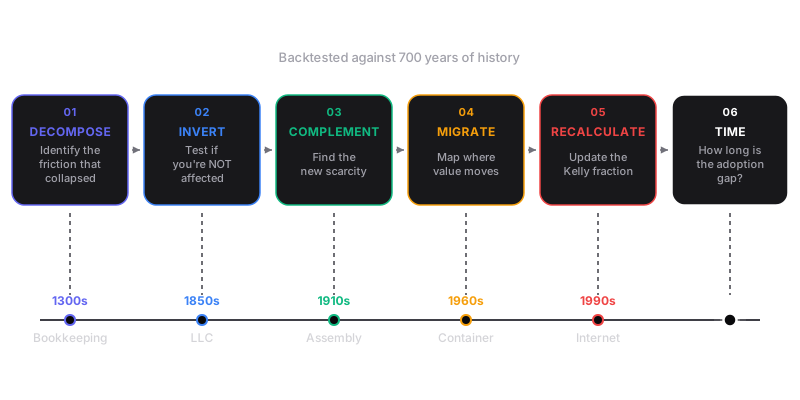
The Five Backtests
For each transition, I’ll highlight the 2-3 most interesting cells - the ones that are surprising or predictive rather than obvious.
Backtest 1: Double-Entry Bookkeeping (1300s)
Friction that collapsed: Trust verification cost between counterparties. Before auditable books, you could only transact with people you knew personally.
Best cells:
COMPLEMENT. When trust verification becomes cheap, what’s scarce? Not capital - capital became more available, not less, because strangers could now pool investments. The scarce complement was deal flow: knowing where to deploy newly-trustable capital. The Medici’s real asset wasn’t their money. It was their network intelligence about which ventures in which cities were worth funding. The information layer on top of the trust layer.
RECALCULATE. Old Kelly fraction: only transact with people you know personally (trust is scarce, so bet only where trust exists). New Kelly: transact with anyone who has auditable books. The number of rational trading partners increases from dozens to thousands. The Medici’s strategy was a Kelly recalculation before Kelly was born - many transactions across a wide network of auditable counterparties rather than a few large transactions with trusted friends.
TIME. Venetian merchants used double-entry methods by the late 1200s. The Medici adopted them aggressively in the early 1400s. Pacioli codified the method in 1494 - by which point the Medici had 100+ years of institutional learning. Rival banking houses that adopted Pacioli’s method in the 1500s couldn’t replicate the network effects and trade intelligence the Medici had compounded. The adoption gap was measured in generations.
Backtest 2: Limited Liability (1850s)
Friction that collapsed: Personal financial ruin risk from business ventures. Before limited liability, a failed business meant losing everything.
Best cells:
INVERT. “What would have to be true for wealthy incumbents to be unaffected?” Their competitors would have to not exploit the new risk structure. The middle class would have to remain too conservative to start businesses even with capped downside. Neither condition held. Within a decade, business formation rates surged. This inversion test is particularly sharp because it predicts who gets disrupted (incumbents whose moat was willingness to bear risk) and who doesn’t (those with moats in relationships, regulation, or proprietary knowledge).
MIGRATE. Value moves from the wealthy risk-bearer to the skilled operator. Before limited liability: the person who funds the venture captures most value because they bear all the risk. After: capital is less scarce (anyone can risk a bounded amount), and operational skill becomes more scarce. This is the birth of professional management as a distinct value layer. The CEO job exists because limited liability made capital cheap and execution expensive.
RECALCULATE. This one is visceral. Old Kelly: only start a business if you can survive total loss. New Kelly: invest bounded amounts across multiple ventures. Limited liability is literally the enabling mechanism for diversified investment portfolios, venture capital, and the modern corporation. Every VC fund is running a post-limited-liability Kelly fraction.
Backtest 3: Assembly Line (1910s)
Friction that collapsed: Skill-per-unit-produced. Each automobile required craftsmen who understood entire assembly. Ford decomposed this into 84 discrete steps.
Best cells:
INVERT. “What would have to be true for craftsmen to be unaffected?” Customers would have to value hand-crafted uniqueness over price and consistency. For luxury goods: the inversion holds. Rolls-Royce still exists. For mass market: the inversion fails completely. The Model T went from $850 to $260 while wages rose. This cell correctly predicts the luxury/commodity split that still defines manufacturing today.
COMPLEMENT. Physical execution becomes abundant. What’s scarce? Design. Quality control. Management. Marketing. The entire white-collar middle class of the 20th century is the scarce complement to abundant factory execution. This is arguably the most consequential complementary scarcity in history - it created the modern economy.
RECALCULATE. Ford’s $5/day wage wasn’t altruism - it was a Kelly recalculation. If your workers can afford your product, your addressable market expands by orders of magnitude. The rational bet size on production capacity increased enormously. Companies that invested aggressively in factory capacity captured the market. Companies that invested cautiously fell behind in scale.
Backtest 4: Containerization (1956)
Friction that collapsed: Cargo handling cost and time. From $5.86/ton to $0.16/ton.
Best cells:
DECOMPOSE. The friction wasn’t just “shipping is expensive.” It decomposed into: physical handling (collapsed), customs documentation (partially reduced), damage and theft risk (collapsed), schedule reliability (dramatically improved). The deepest impact was intermodal - the same container goes ship to truck to rail without unpacking. The people who understood which components collapsed and which didn’t made the right bets.
MIGRATE. Value moves from dock labor (execution) to supply chain design (orchestration). Walmart’s competitive advantage IS supply chain orchestration - they don’t make anything. IKEA designs furniture and manages logistics but manufactures nothing. The entire “asset-light” business model is a value migration from physical execution to orchestration. This cell predicted the structure of global retail 30 years before it happened.
TIME. The Port of Singapore invested aggressively in container infrastructure in the 1960s-70s and became the world’s busiest port. The Port of New York lost massive market share to Newark because Newark rebuilt for containers while New York’s piers couldn’t accommodate them. Those infrastructure decisions in the 1960s determined which cities became global trade nodes for the next 50+ years.
Backtest 5: Internet + E-Commerce (1995)
Friction that collapsed: Distribution cost - to near-zero for information goods, dramatically reduced for physical goods.
Best cells:
INVERT. “What would have to be true for brick-and-mortar retail to be unaffected?” Customers would have to value the physical experience over convenience and price. For commodity goods: inversion fails completely. Borders and Circuit City are gone. For experiential retail: inversion partially holds. Trader Joe’s and Costco are thriving (experience and curation moats). This cell correctly predicted which retail segments survived and which didn’t.
COMPLEMENT. Distribution free -> what’s scarce? Attention (when everything is available, awareness is the bottleneck - hence Google). Trust (when anyone can sell, reputation is critical - hence Amazon reviews). Curation (when selection is infinite, filtering is valuable - hence Netflix recommendations). Logistics (the physical last-mile remained scarce and became Amazon’s deepest moat). Four distinct scarcities from one abundance.
RECALCULATE. Amazon bet aggressively on infrastructure when B&N was still running the old Kelly fraction. The cost of listing a new product was near-zero, so the rational catalog size increased by orders of magnitude (the “long tail”). B&N’s bets were sized for a world where distribution cost was high. Amazon’s were sized for a world where it was zero. By 2005 the gap was insurmountable - not because Amazon was smarter, but because they recalculated first.
The Proof
Five transitions. Thirty cells. No empties. Every cell predicts something specific and retrospectively testable.
The protocol isn’t a narrative that happens to fit history. It’s a structural description of how friction collapses propagate through economies. The content changes. The structure doesn’t.
Which means we can apply it forward.
The Sixth Application: LLMs
Friction that collapsed: The marginal cost of intellectual output production - text, analysis, classification, summarization, translation, code generation - drops by 10-100x.
The full protocol, applied to LLMs:
DECOMPOSE
The friction isn’t “AI is powerful.” It’s specific: producing a unit of intellectual output used to cost the hourly rate of a knowledge worker. Now it costs tokens.
But the friction decomposes. Product categorization: fully automatable. Contract review: the clause-extraction component collapses, but the judgment-about-risk component doesn’t. Financial analysis: the data-gathering and formatting collapse, but the forward-looking inference doesn’t. Customer support: first-response collapses, but escalation-requiring-judgment doesn’t.
The businesses that navigate this well will be the ones that decompose their intellectual labor into components and identify which components collapse and which don’t - exactly like the scribes who survived the printing press by understanding their friction at the component level.
INVERT
“What would have to be true for your expertise-as-a-service business to be unaffected by a 10-100x drop in intellectual output cost?”
Your intellectual output would have to be so brand-distinctive that automated output can’t substitute. Your customers would have to value the human relationship, not the output. Regulatory requirements would have to mandate human-produced work. Your proprietary data would have to be irreplaceable.
Test those conditions honestly. For commodity legal review, boilerplate financial analysis, template-driven consulting: the inversion fails. For highly contextual advisory, relationship-based sales, regulatory-mandated human oversight: the inversion holds.
Most businesses have revenue streams in both categories. The inversion test tells you exactly which ones are exposed.
COMPLEMENT
Intellectual output becomes abundant. What becomes scarce?
Context. The LLM is generic. Your data, your customer relationships, your domain knowledge - these are specific. A retailer with 10 years of transaction data has an asset that competitors can’t replicate and that makes LLM output dramatically more valuable.
Judgment. Knowing what to produce, for whom, when to override the machine. The editor becomes more valuable when writing is cheap, not less.
Orchestration. The skill of designing intellectual production systems - decomposing tasks, building pipelines, managing quality. This is the “factory designer” of the knowledge economy.
Accountability. When anyone can generate plausible text, the human who stands behind a claim and bears consequences becomes more valuable. Trust appreciates when production is cheap.
MIGRATE
The analyst loses margin. The pipeline builder captures it.
This is the same migration as every prior transition: execution -> orchestration. Specifically:
| Old Role (Execution) | New Role (Orchestration) |
|---|---|
| Analyst who produces reports | Architect who designs reporting pipelines |
| Writer who writes content | Editor who knows what’s worth writing |
| Coder who implements features | System designer who decomposes problems |
| Reviewer who reads contracts | Pipeline builder who automates extraction |
| Support agent who answers tickets | Triage designer who routes and automates |
The value isn’t in any product the pipeline produces. It’s in the pipeline itself. When you build a system that produces contracts, reports, or product descriptions at near-zero marginal cost, the pipeline is a capital asset. The intellectual labor has been captured, not in a person who can quit, but in a system you own.
This is what “capitalizing intellectual labor” means. It’s the same shift the assembly line created for physical goods.
Real numbers composited from multiple engagements:
| Task | Old Cost (per unit) | New Cost (per unit) | Capital Investment | Payback |
|---|---|---|---|---|
| Product categorization | $0.12 (human) | $0.003 (LLM + gate) | ~$15K | 3 weeks |
| Vendor contract review | $400 (legal) | $8 (LLM + spot check) | ~$40K | 2 months |
| Customer email triage | $2.50 (agent) | $0.08 (LLM classification) | ~$20K | 6 weeks |
| Data entry from PDFs | $0.50 (offshore) | $0.02 (extraction pipeline) | ~$25K | 4 weeks |
In every case: upfront capital investment creates a system that replaces ongoing expense. The economics look like software, not services.
RECALCULATE
This is the most actionable cell. Your current investment in AI experiments is almost certainly too low.
Old cost structure: building an intellectual pipeline was $50-500K. You needed high confidence and high volume to justify the bet. New cost structure: building a pipeline is $5-50K. The evidence threshold for “should we try” should be 10x lower.
Most companies I talk to are running 0-2 AI experiments. The Kelly-optimal number, given the new cost structure, is usually 8-15. They’re using the old fraction.
The companies building 10+ pipelines in parallel right now are doing what Amazon did in 1997: sizing bets for the new cost structure while competitors debate whether the technology is real.
TIME
We’re at roughly “1997 internet” for LLMs. The technology is clearly real. The infrastructure is building. But most companies haven’t built their pipelines yet.
The compounding advantage of early adoption is massive. Each pipeline you build teaches you how to build the next one faster. Your team develops institutional knowledge about what works. Your data improves. Your quality gates get tighter.
Historical pattern: by the time the late majority adopts, the early adopters have 3-5 year structural advantages that are nearly impossible to close. Amazon’s logistics network. Google’s data flywheel. The Medici’s branch banking system.
The cost of 12 months of delay isn’t just the foregone savings. It’s the competitive positioning erosion from letting faster-moving companies build institutional AI knowledge that you don’t have.
Who Wins, Who Loses
The protocol predicts:
Winners:
- Companies with proprietary data (COMPLEMENT - context is the scarce resource)
- Companies with high-volume repetitive knowledge work (RECALCULATE - more units = faster payback)
- People who build the pipelines (MIGRATE - orchestration captures value)
- Companies that move now (TIME - compounding advantage)
Losers:
- Expertise-as-a-service with undifferentiated output (INVERT - friction IS intellectual production)
- Companies treating AI as a cost center, not capital investment (MIGRATE - buying tickets vs. building systems)
- People whose value is “I just know” without ability to externalize (DECOMPOSE - tacit knowledge that can’t be specified can’t be pipelined)
- Companies waiting for more evidence (TIME - the evidence will come, but the compounding window will have closed)
None of this is mysterious. It’s the same pattern that has played out at every transition for 700 years.
The Uncomfortable Implication
Double-entry bookkeeping didn’t just make trade more efficient. It created modern capitalism. The assembly line didn’t just make cars cheaper. It created the middle class. The internet didn’t just make shopping more convenient. It redistributed trillions in value from physical retail to digital platforms.
If LLMs genuinely make it possible to capitalize intellectual labor - and the evidence from the MIGRATE analysis is strong that they do - the structural change won’t be “companies save 20% on knowledge work.”
It’ll be a redistribution of value as fundamental as the shift from craftsmen to factories.
The operators who recognize this and start building capital systems - not buying AI tickets - are the ones who capture the value. The protocol tells you where to look. The historical record tells you what happens to those who wait.
Go deeper: Knowledge Capital formalizes why intellectual labor capitalizes into an appreciating asset under AI. Any Sufficiently Advanced Technology: A Taxonomy of Magic runs the 6-step protocol across five other historical transitions and stress-tests the pattern.