Dual Curve
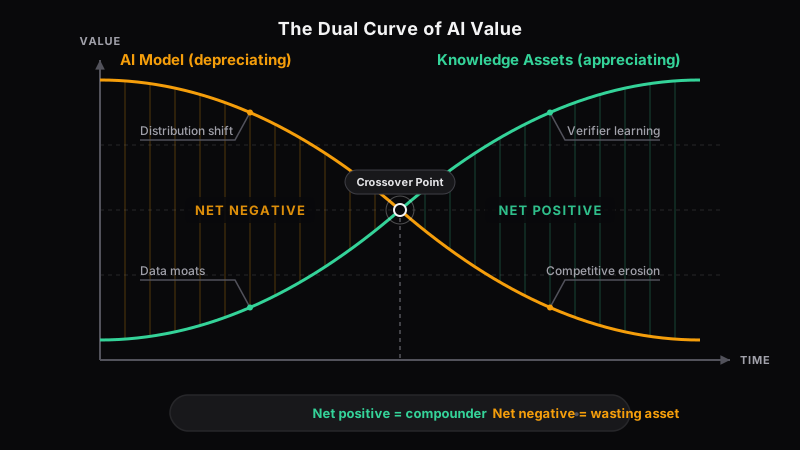
The simultaneous depreciation of AI models (distribution shift, competitive erosion) and appreciation of knowledge assets (verifiers, labeled corpora, institutional rubrics) - where the appreciating side gets better through operating use, not in spite of it. The net rate determines whether an automation is a wasting asset or a compounder.
Why It Exists
Physical capital allocation assumes depreciation. Knowledge capital allocation has both curves running at once - and the appreciating side is structurally unusual because it ratchets up with use rather than down. Invest in the appreciating side (verifiers, data) not the depreciating side (models).
Rosetta Stone
Four circles, four readings of the same object. Each role reads the artifact through its own lens.
Two depreciation schedules that net against each other. The model depreciates with distribution shift; the verifier and data appreciate with coverage. Net sign determines compounder vs wasting asset.
The reason last year's AI project still works - the data you collected got better even as the model got worse. Or the reason it stopped: you upgraded the model but never invested in the verifier.
Model decay vs data moat. Two curves running simultaneously. Most teams only track one.
Two stochastic processes with opposite drifts. The combined value is their sum; the sign of the derivative determines asset class (compounder if positive, wasting if negative).
Related Terms
Construction Spread - S = (annual_value x P(success)) / build_cost.
Compile Time - Time spent building systems, frameworks, rubrics, and processes that produce returns across many future periods.
Frameworks & Tools
See also
Which bets to make. Capital allocation, M&A due diligence, portfolio construction.
How to execute at scale. Multi-brand portfolio, turnarounds, P&L ownership.
Builds it, ships it, owns it. Solo full-stack, DevOps, production systems.
Proves it, models it, publishes it. Mathematical modeling, Bayesian frameworks.