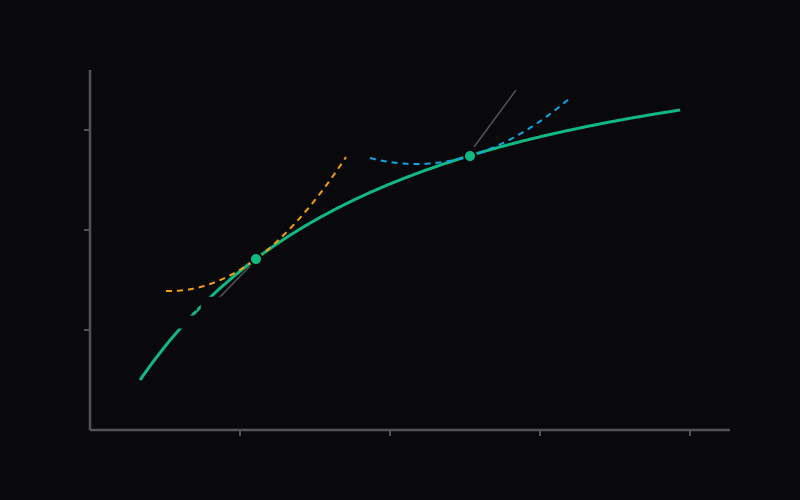
Stop pricing projects against one hurdle rate. Pick a point on the frontier on purpose.
Cash, runway, covenants, and narrative are a function, not a scalar; write it down and two allocators get the same answer.
What Goes Into The Map
Cash and runway. How long until the firm needs to raise or cash-flow? A firm six months from a raise cannot absorb a left-tail outcome on a concentrated instrument. A firm two years from a raise can.
Margin targets. Public guidance, covenant floors, FY plan commitments. Each of these is a left-tail constraint that rules out portfolios whose -2σ scenario violates the number.
Narrative and board expectations. The firm is telling the board a story about where value comes from. The story constrains the portfolio as much as the math does. A firm selling growth cannot pick the minimum-variance frontier point, even if the math permits it.
Correlation with existing portfolio. The firm already has instruments in flight. The new allocation decision is marginal, not standalone. Risk tolerance is defined on the whole portfolio, not the incremental slot.
Why this matters
Most corporate capital budgeting skips this step. Projects are evaluated one at a time against a hurdle rate. The hurdle rate implicitly encodes a risk tolerance - but a single scalar cannot capture the left-tail constraints, the correlation structure, or the narrative. The risk tolerance map replaces the implicit scalar with an explicit function. Two implications: (1) the firm’s decisions become legible to the board and auditable over time; (2) two allocators using the same map produce the same answer, which is the definition of a repeatable process.
Rosetta Stone
Four circles, four readings of the same object. Each role reads the artifact through its own lens.
The function mapping firm-level constraints - cash, runway, margin guides, covenants, narrative - into the preferred point on the efficient frontier. Two allocators with the same frontier and different firms pick different portfolios. The map is what makes both answers correct.
What the firm can actually tolerate losing. "We can't miss the margin guide" is a left-tail constraint; "we need to prove growth" is a mean-maximization constraint. Different tolerances, different Q3 plans.
The engineering version: "we can't miss the release" vs "we need to learn the shape of the feature." One favors safe plays; the other favors high-variance experimentation. Same team, different answers.
A utility function over portfolio outcomes. Under quadratic utility, selects a single point on the Markowitz frontier; under CRRA or CARA, the map is richer. Explicit utility replaces the implicit hurdle-rate scalar of standard capital budgeting.
Related
- Efficient Frontier - the set of portfolios you are selecting from.
- Correlation - determines the shape of the frontier you are mapping onto.
- Capital Allocation - the Stage 3 spine that composes frontier, tolerance, and correlation.
Falsifiable prediction
A falsifiable prediction from this framework: two firms with similar instrument menus and frontiers but materially different capital structures, runway, or covenants will pick measurably different portfolio compositions - and the gap will track the tolerance map, not the frontier shape. If their realized portfolios converge despite different constraint sets, either the constraints aren't binding (rare in PE portcos), or the risk-tolerance map is mis-specified - usually because narrative and covenant drag are treated as soft when they are actually hard.