The Demand Field
Standard brainstorming asks “what can we build with this technology?” This produces solutions looking for problems. The Demand Field inverts it: your optimization problem has a fixed, hidden force called demand. Your job is to characterize it and then address it in continuously more optimal ways.
The Axiom
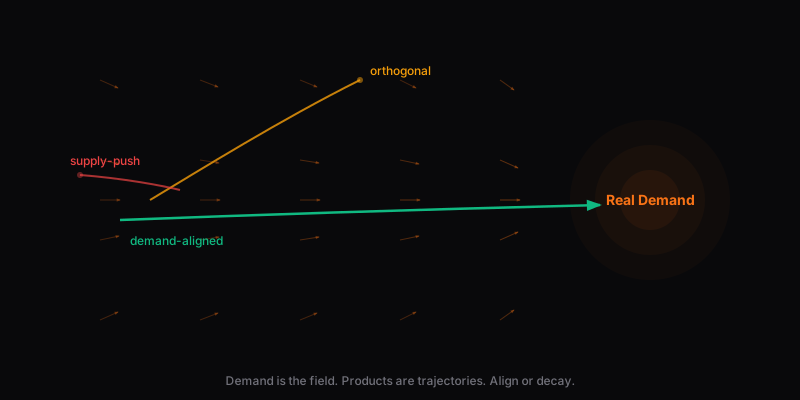
Demand is a force field on your optimization landscape. It has three properties: it is fixed (you cannot change what people fundamentally want), hidden (you must discover it through observation, not introspection), and it acts on your gradient whether you account for it or not.
Three Properties
You cannot change what people fundamentally want. Couples have disagreed about aesthetics for centuries. Homeowners have agonized over renovation choices since houses existed. The means of addressing these needs changes every decade. The needs themselves do not. Demand is a human constant, not a market variable.
What people say they want and what they actually want diverge reliably. You discover real demand through observation - watching what people do when stakes are real, measuring what they choose when alternatives exist, tracking where money actually flows. Not through surveys, not through focus groups, not through asking.
Every product trajectory is pulled by the demand field. Building orthogonal to it is like building against gravity - you can do it, but you are fighting a force you have not measured. Many failed startups were not bad at execution. They were executing orthogonal to where demand was pulling.
The Technique: Demand-Fixed Innovation
Instead of “what can we build?” (supply-side), ask “what demand is poorly served?” (demand-side). Fix demand as the immutable constraint. Vary the means of addressing it.
Fix the demand
Pick a real, validated human need. Not “people need better tools” but “couples making 50+ aesthetic decisions under time pressure disagree and waste money on revisions.” Name the buyer. Name the pain. Name the current inferior means.
Characterize the current means
How is this demand currently met? Pinterest boards, committee meetings, gut feeling, hiring an expensive consultant. What is broken about the current means? Slow, uncalibrated, does not surface disagreement, no uncertainty quantification.
Insert the novel technology
How does the technology address the same demand differently? What properties does it have that the current means lacks?
Identify the delta
The opportunity lives in the gap between the current means and the technology-enabled means. The larger the delta along dimensions the buyer cares about (speed, cost, calibration, alignment), the larger the opportunity. The delta IS the entrepreneurial signal.
The Complement Principle
When a resource becomes abundant, its complement becomes scarce. That is where the demand field pulls hardest.
This is not speculation. It is economics. The technology transition makes generation free and selection expensive. The demand field always pulls toward the scarce complement of the abundant resource.
Worked Example
A novel technology: Bayesian conjoint engine with D-optimal pair selection. Instead of asking “what can we build with this?” ask “what demand is poorly served?” Then iterate:
| Fixed Demand | Current Means | Delta |
|---|---|---|
| Couples choosing aesthetics | Pinterest boards, arguments | Quantified disagreement via joint posterior; 5 min vs 5 meetings |
| Homeowners choosing finishes | Showroom trips, analysis paralysis | Converges in 100 votes; posterior transfers across rooms |
| Brand agencies aligning | 3 mood boards, revision cycles | Preference DNA deliverable; saves 2-3 rounds |
| Product teams choosing direction | Committee meetings, HiPPO | Per-stakeholder decomposition with uncertainty |
| Campaigns testing messaging | Focus groups, expensive polling | Feature-level resonance decomposition by segment |
Five distinct business models in five minutes. Every row fixes a different demand. The technology is constant. You are iterating on demand, not technology.
Anti-Patterns
How to Run This
- 1. Write the technology description in one paragraph (what it does, not how)
- 2. Set a 10-minute timer
- 3. Generate demand statements: “[Specific person] needs to [specific outcome] and currently uses [specific inferior means]”
- 4. For each demand, write the delta in one sentence
- 5. Rank by: buyer clarity x willingness-to-pay x delta magnitude
- 6. Top 3 are worth deeper investigation
Connection to Other Frameworks
The Performance Frontier - demand defines where the frontier IS. The frontier is not “what we can build” but “what the demand field is pulling toward.”
Designed Convergence - the demand field is the terminal state. Design the game so agents converge toward it.
Demand Gravity - the colloquial term for the pull of real demand on product trajectories.