Knowledge Work as Capital
Most companies treat knowledge work as an expense. Someone does analysis, produces a deliverable, the cost hits the P&L, and that is the end of the story. But if that work product is structured, versioned, and connected to a measurable outcome, it stops being a cost and starts being an asset - one that can appreciate over time the way physical capital never does.
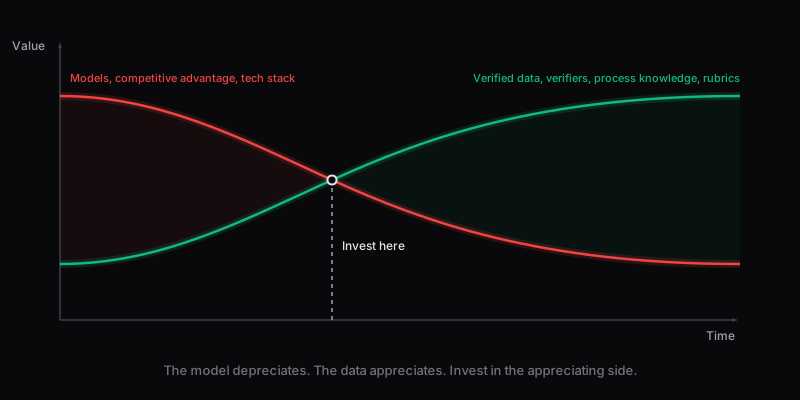
The Dual Curve
Physical assets depreciate. A truck loses value from day one. A warehouse degrades. A machine wears out. The NPV calculation bakes in declining value.
Knowledge assets have a dual curve. Some components depreciate. Some appreciate. The net rate determines whether you are building a wasting asset or a compounding one.
Depreciates
- ↓Models - distribution shift degrades performance over time
- ↓Competitive advantage - others build the same capability
- ↓Technology stack - obsolescence, version churn, API changes
- ↓Individual knowledge - walks out the door when the person leaves
Appreciates
- ↑Verified data - each run generates labeled examples
- ↑Verifiers - each failure case makes them smarter
- ↑Process knowledge - understanding where failures cluster is cumulative
- ↑Institutional rubrics - codified judgment that survives personnel changes
The Investment Implication
The optimal strategy follows from the dual curve: invest in the appreciating side.
Use commodity models - they are the truck. Replaceable, depreciating. Do not build custom models unless the data moat justifies it.
Build proprietary verifiers and data pipelines - they are the land under the depot. Unique, compounding, increasingly expensive for a competitor to replicate.
The Automation NPV calculator models both curves. When appreciation exceeds depreciation, the knowledge asset is a compounder. When it does not, it is a wasting asset - and you should stop investing.
Compile Time vs. Runtime
This framework changes how leaders should spend their time.
Compile Time
Building systems, frameworks, rubrics, processes. Creating assets that produce returns over many future periods.
Writing the verifier. Designing the rubric. Building the graph. Defining the cost function. Creating the case form.
Runtime
Executing tasks, fighting fires, reviewing outputs. Consuming assets that produce returns in a single period.
Running the report. Reviewing the output. Approving the request. Attending the meeting. Answering the email.
Every hour of compile time produces returns across all future periods. Every hour of runtime produces returns in exactly one period. The ROI of compile time is multiplicative. The ROI of runtime is additive. Leaders who spend most of their time in runtime are choosing the additive path.
Proof of Trust Is the New Scarcity
When knowledge generation is cheap - when any LLM can produce analysis, hypotheses, content, decisions - the scarce resource is proof that you can trust the output.
This is why the Proof Layer is built before the capability. Every knowledge asset needs: