Your Chart of Accounts Is a Directed Graph
Every business has a chart of accounts. Most people treat it as a flat list of categories. It is not. It is a directed graph - nodes are your cost and revenue lines, edges are causal relationships between business activities and financial outcomes. The goal is to find the soft spots - edges where value is leaking that no one has named yet.
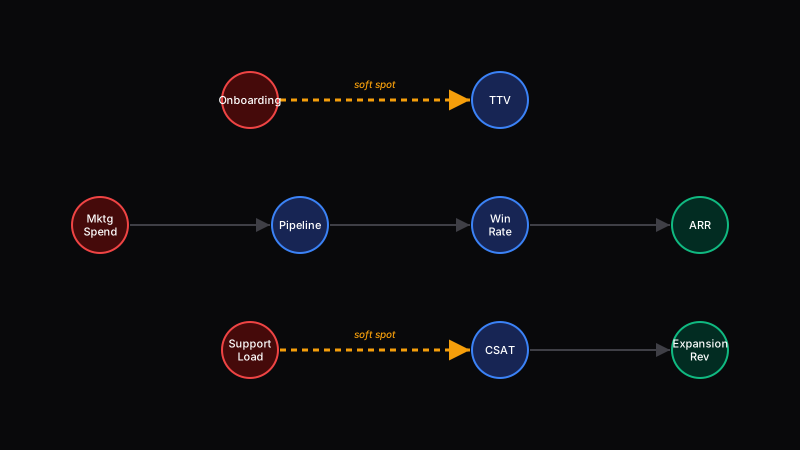
The Model
A node is any line in your P&L that you can measure: a cost center, a revenue line, a conversion metric, a quality score.
An edge is a causal relationship: “onboarding friction delays time to value,” “support load erodes satisfaction,” “pipeline quality drives win rate.” These are not correlations. They are directional causes that propagate through your business.
A soft spot is an edge where value is leaking and no one has named it yet. Every business has them. Most of the time, the people closest to the work already feel them - they just lack the language to surface them to leadership.
Example: SaaS P&L Graph
Click an edge to see the causal relationship. Amber edges are soft spots.
Finding Soft Spots
The people closest to the work already know where the soft spots are. They feel them every day. They just lack the vocabulary to name them as edges in a graph that leadership can act on. Three questions surface them:
Where do you lose the most time between receiving an input and producing an output?
Which part of your process exists only because another part fails silently?
If you had to cut one step and absorb the consequences, which step would cause the least damage?
Feed every response into the graph. Map each answer to a node or edge. The soft spots cluster. The highest-value intervention is usually sitting in the intersection of those answers.
Why This Works
Today: A couple of key executives intuitively understand where value leaks in the business. They carry the map in their heads. When they leave, the map leaves with them. Everyone else describes problems in their own local vocabulary - “onboarding is slow,” “support is overwhelmed” - without connecting those complaints to financial outcomes.
Tomorrow: The graph gives the entire organization a shared language. When anyone - from a frontline rep to a VP - can say “there is a soft spot on the edge between onboarding friction and time to value,” that complaint is now actionable. It maps to a node. It connects to a dollar amount. It can be prioritized.
The power of the directed graph is not the math. It is the network effect of shared language. Every person who learns to name edges and soft spots becomes a sensor for value leakage. The more people speak the language, the more signal leadership gets, and the faster the organization names the leaks that were hiding in plain sight.
From Graph to Action
Once you find a soft spot, the AI Operations Tools evaluate what to do about it:
Thanks to James Garvey for encouraging me to formalize and publish these frameworks.