What You Get For Your Attention
Every post ships against an 8-dimension rubric. Here it is. Hold me to it.
The Rubric
Operational Depth
Written by someone who runs production systems, not someone who reads about them. First-hand experience with real stakes, real P&L, real consequences.
Technical Rigor
Holds up to scrutiny from a serious engineer. Mathematical grounding where appropriate. No hand-waving past the hard parts.
Actionability
You leave with something you can use. Not "think about X" but "here is how to do X, and here is what happens when you try."
Evidence Density
Every claim backed by data, code, direct experience, or citation. No assertion without support.
P&L Literacy
Connects technical decisions to business outcomes. Engineering exists inside an economic context and the content reflects that.
Specificity
Named technologies, exact numbers, real examples. Not "a large company" but "$900M revenue retailer." Not "significant improvement" but "92% cost reduction."
Structural Clarity
Scannable and navigable. Respects your time. You can get 80% of the value from headings and bold text if you are in a hurry.
Intellectual Honesty
States what it does not know. Acknowledges trade-offs. Does not oversell. If the evidence is weak, says so.
Where These Fail
Some dimensions have hard floors. Below the floor the content is not worth your time:
- Operational depth below threshold = advice from someone who has not done the thing. Worthless.
- Technical rigor below threshold = cannot be trusted by someone who knows the domain. Dangerous.
- Evidence density below threshold = assertions without proof. Indistinguishable from opinion.
- Specificity below threshold = generic advice that applies to everyone and helps no one.
Some have ceilings where more is not better:
- Evidence density past ceiling = reads academic and defensive. Over-citation for its own sake.
- Structural clarity past ceiling = feels like a template. Formulaic.
The combination of operational depth, technical rigor, P&L literacy, and mathematical grounding in one place is what is rare. Most technical writing skips the business context. Most business writing hand-waves the technical details. Most of both skip the math.
For context: Group CTO at a PE-backed retail holding company (~$900M revenue). This is where the operational depth and P&L literacy come from.
Where This Sits
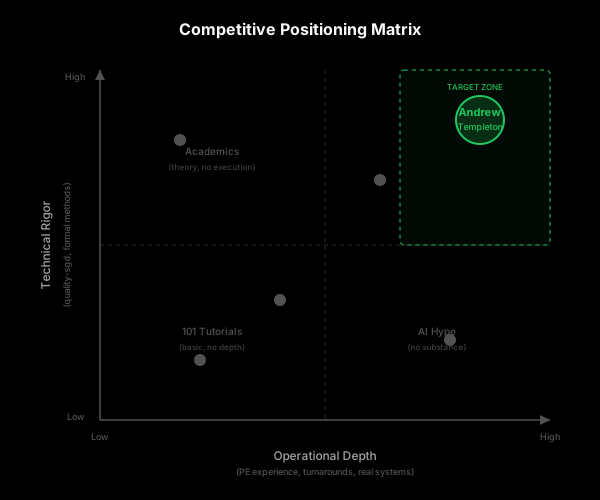
Most content either has operational experience without rigor, or theoretical rigor without real-world deployment. The rubric above exists to prevent both failure modes.
What This Covers
AI Operationalization
Production AI deployment patterns - quality tiers, P&L mapping, graduated autonomy. How to underwrite AI investments and know when they are working.
Technical Leadership
PE portfolio dynamics, turnarounds, M&A integration, building engineering organizations. What actually happens inside the operating company.
Quality Systems
Metrics as gradients, quality topology, convergence properties. Rigorous systems thinking applied to inherently fuzzy software problems.
Self-Taught Path
Career leverage and learning systems for technical leaders without traditional credentials. Occasional (1 in 4 posts), not primary.
If something I published fails one of the 8 dimensions above, I want to know. The rubric is how you hold me accountable - not how I market to you.
admin@templeton.host