The Verification Quadrant
Based on the Templeton Ratio™
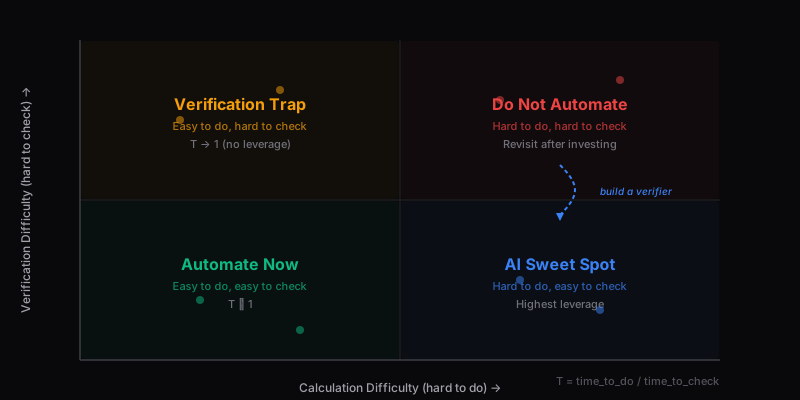
Before automating a task with AI, ask two questions: How hard is it to do? and How hard is it to check? The ratio between these two numbers - the Templeton Ratio - determines whether AI will save you time or double it.
The Templeton Ratio
AI value is not determined by how impressive the output looks. It is determined by one number: how much cheaper it is to check than to produce.
The Verification Quadrant maps the two components of this ratio. Tasks in the AI Sweet Spot have high T - hard to calculate, easy to verify. This is the P vs NP intuition applied to operations. Generating a solution is expensive. Checking it is cheap. That asymmetry is where automation creates leverage.
The Verification Trap kills more AI pilots than technical failure. The task looks automatable because generation is easy. But "is this output correct?" requires human judgment that scales linearly with volume. T approaches 1. You end up paying for generation and review instead of just doing the work once.
How to Score a Task
Calculation Difficulty
How hard is it for a human to produce correct output?
Verification Difficulty
How hard is it to determine whether the output is correct?
Decision Rules
* The Capital Value of Verifiers
The quadrant above describes the current state of a task. It is not permanent.
If you can build a verifier - a system that cheaply and reliably checks whether an output is correct - you shift that task downward on the diagram. What was "hard to verify" becomes "easy to verify." A task that sat in Do Not Automate moves into the AI Sweet Spot. A task stuck in the Verification Trap drops into Automate Now.
This is a legitimate capital investment. Building a high-quality verifier is often harder than building the generator. It requires deep domain knowledge, careful rubric design, and usually a blend of deterministic checks and calibrated scoring. It is not cheap to build. But the payoff is structural: once the verifier exists, every unit of AI output can be checked at near-zero marginal cost, and the entire task permanently moves quadrants.
The companies that are winning at AI are not the ones picking easy tasks. They are the ones building verifiers that increase their Templeton Ratio - making hard tasks easy to check, then running those tasks at scale.